Sure, below is a complete, professional article created based on the reference material you provided, with an estimated length of about 2,270 Chinese characters.
UK Critical Minerals Strategy: £50 Million Investment to Reshape Global Supply Chain Resilience
Abstract
Against the backdrop of profound changes in the global geopolitical landscape and intensifying competition in key technology industries, the stable supply of critical minerals has become a strategic cornerstone of national economic security and technological sovereignty. The UK government recently announced a major investment plan totaling £50 million (about US$66 million) to systematically expand domestic critical minerals production capacity. This move is not only a hedge against the current high concentration of global supply chains, but also signals that the UK is building, at the national strategy level, a closed-loop mineral security system from mining and processing to recycling. This article provides an in-depth analysis of the investment's components, strategic intent, and its far-reaching impact on the future of UK industry and the restructuring of global supply chains.
Keywords: critical minerals; supply chain resilience; rare earth magnets; industrial strategy; UK economic security
1. Introduction: From Global Dependence to Local Security
As the world moves toward net-zero emissions and digital transformation, the value of lithium, cobalt, rare earths and other critical minerals has been magnified like never before. They are not only core components in consumer electronics such as smartphones and computers, but also indispensable "industrial vitamins" for electric vehicle batteries, wind turbine generators and advanced military equipment. However, the global supply chain for critical minerals is highly concentrated geographically. For example, the vast majority of rare earth mining and processing is concentrated in China, while cobalt refining is heavily dependent on capacity in the Democratic Republic of the Congo and China. This single-point-failure global network has repeatedly been hit in recent years by trade frictions, geopolitical conflicts and natural disasters, exposing its inherent fragility.
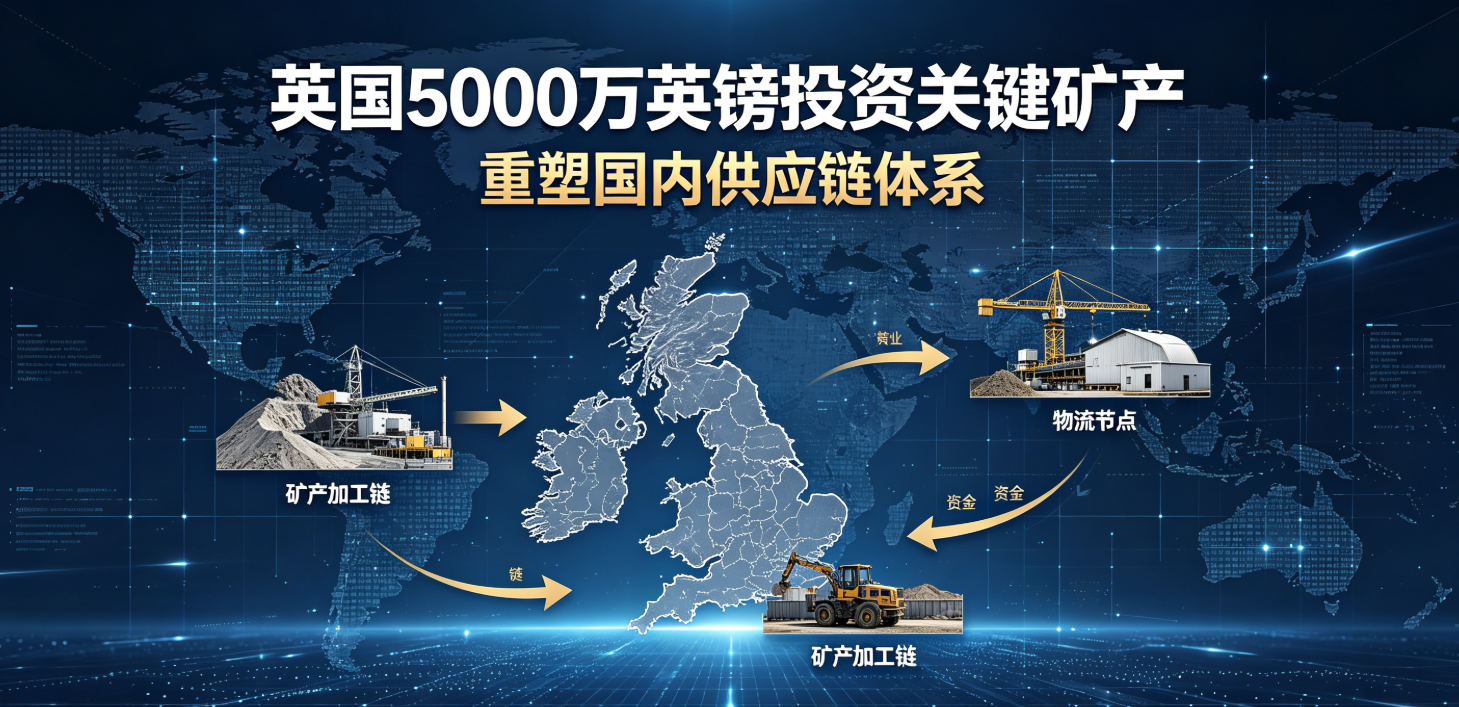
On Monday local time, the UK government made a decisive move by announcing a £50 million investment plan aimed squarely at expanding and upgrading the domestic critical minerals industry. Industry Secretary Chris McDonald formally launched the ambitious plan during a visit to an industrial research center in northeast England focused on metal recycling and processing technologies. The core logic is clear and firm: build domestic "mineral sovereignty" through active investment, reduce excessive dependence on overly concentrated overseas supply chains, and thereby systematically strengthen the resilience of the UK economy and national security. The UK government had previously pledged more than £200 million to support mining development, and this new injection of funds is undoubtedly one of the most important parts of that broader strategy.
2. Authoritative Interpretation: Why Critical Minerals Are a National Priority
During the visit, Industry Secretary Chris McDonald made the government's strategic considerations clear to the media. He stressed: "Critical minerals are extremely important to our national security." These few words are not empty rhetoric, but a rational conclusion drawn from long-term observation.
In civilian use, the UK plans to ban the sale of new gasoline and diesel cars by 2030 and vigorously develop wind power and energy storage systems. That means demand for electric vehicle batteries (which require lithium, cobalt, nickel and manganese) and rare earth permanent magnets (used in motors and generators) will grow exponentially over the coming decades. If the UK remains highly dependent on imports, the lifeline of its industry will be in the hands of others, and any supply disruption could shut down car plants and delay clean-energy projects, inflicting a fatal blow on industrial transformation.
From a defense-security perspective, high-grade rare earth permanent magnets are core components in advanced fighter radar systems, precision-guided weapons and submarine sonar systems. The UK is an important NATO member and a major global defense exporter. Ensuring endogenous supply capacity for these key raw materials is not only an economic consideration, but also a necessary prerequisite for maintaining independent decision-making in a complex geopolitical environment. McDonald's remarks elevate this investment plan from an "industrial policy" to a "national security strategy."
3. Three Strategic Pillars of the Investment Plan
This £50 million is not being spread thinly; it is a precisely designed targeted investment focused on three key areas, forming a closed-loop ecosystem of "R&D - scaling - financing."
1. Core Engine for Innovation: The Rare Earth Magnet Center (£20 million)
Rare earth magnets, especially neodymium-iron-boron permanent magnets, are the efficiency core of electric vehicles, wind turbines, industrial motors and high-end consumer electronics. Yet their production has long been heavily reliant on China. To break this "magnetic lock," the UK government is putting its largest single allocation—£20 million—into building a Rare Earth Magnet Center.
This center is not just a concept on paper; it is directly connected to a domestic industrial breakthrough. The latest progress shows that the UK's first commercial rare earth magnet plant in 25 years has officially begun production. Operated by HyProMag, a company under Birmingham-based Mkango Resources, the plant innovatively uses recycled materials (for example, recovered from discarded hard disk drives and electric vehicle motors) to produce high-performance magnets. Government funding will help such frontier technologies move from the lab to the factory floor and support the integration of upstream and downstream segments of the industrial chain, ultimately forming a globally competitive domestic magnet cluster.
2. A Catalyst for Scaling Up: The Accelerator Program (£25 million)
When a technology moves from the lab to large-scale commercial application, it often faces a chasm known as the "valley of death." Many promising UK startups shine during the proof-of-concept stage, only to fail because they lack the funding needed for large-scale pilot production and demonstration.
To address this, the government has launched a £25 million "Accelerator Program." Its core goal is to help critical minerals projects with commercialization potential cross the "technology gap" and expand production scale. Whether it is innovative mining methods (such as more environmentally friendly deep mining or lithium extraction from seawater) or breakthrough low-carbon processing techniques (such as rare earth separation methods that avoid highly toxic chemicals), any project that can prove its effectiveness and commercial prospects may receive critical support from this fund. The aim is to make the UK a global hub for "green processing" and "recycling technologies" in critical minerals.
3. Bridging Industry and Capital: The Demand Capture and Investment Platform (£5 million)
Compared with the first two physical projects, this £5 million investment is the smallest in amount, but its strategic significance is equally important. It will be used to establish a platform that "captures industry demand and unlocks private investment."
In the UK, many upstream mining projects and downstream processing projects often face information asymmetry. For example, a mining company may have found an ore body, but not know what specifications downstream processors need; or a technology provider may have a breakthrough, but struggle to attract major investment due to lack of confirmed market demand. This platform will act like a "stock exchange" for the industrial sector, systematically connecting government, upstream extractors, midstream processors, downstream manufacturers (such as Jaguar Land Rover and Rolls-Royce), as well as banks and venture capital firms. By publishing authoritative industry demand forecasts and project white papers, the government will use just £5 million in seed money to leverage substantial private capital into this strategic field and create a powerful multiplier effect.
4. Building a Diversified Global Supply Network: The Power of Allies
While aggressively building domestic capacity, the UK government also recognizes that full self-sufficiency is virtually impossible in the short term. Accordingly, another important part of its strategy is to "build partnerships with like-minded allies" and diversify supply chains.
The UK is actively deepening cooperation with the US, South Korea and other major allies and manufacturing powers. This cooperation is not a simple matter of "buying minerals," but rather focuses on deep supply chain restructuring. Specifically, it focuses on three dimensions: first, the "supply chain architecture" of critical minerals, with both sides jointly mapping more transparent and resilient logistics and transportation routes; second, "joint R&D in processing capacity," especially sharing results in green smelting and separation technologies; and third, an "investment flow reciprocity mechanism," encouraging UK companies to take equity positions in upstream projects in the US or South Korea while welcoming allied capital to participate in the UK's magnet recycling and processing projects.
This dual-track strategy of "strengthen internally + align externally" allows the UK to take the initiative in international economic competition. Through mineral cooperation memoranda signed with the US and South Korea, the UK has secured alternative sources of supply for its automotive and aerospace industries, greatly reducing the risk of relying on a single supplier.
5. A Deeper View: The Awakening of New Industrial Realism
Looking at the UK's £50 million investment, it reflects a profound new industrial realist mindset. Over the past few decades, developed Western countries generally outsourced the production of critical minerals to lower-cost countries, focusing instead on high-value-added financial and design services. However, the impact of the pandemic, lessons from chip shortages, and the energy crisis triggered by the Russia-Ukraine conflict have made the UK deeply aware that without supply chain security in real industry, everything is just an edifice in the air.
The UK's plan is precisely a forceful correction of this deindustrialization trend. It no longer relies solely on the perfect assumptions of global free trade, but instead takes active steps to use public finance to "create" industrial advantages and "guide" investment direction. This intervention is not meant to create a closed or protectionist system, but to build a diversified, open, yet more resilient supply system that is traceable from source to end use.
It is worth noting that this round of investment places special emphasis on "recycling and the circular economy." HyProMag's success shows that by recovering rare earths from waste electronics and industrial equipment, the UK can gradually build an urban mine without increasing new mining volume and while reducing environmental impact. This not only aligns with the global ESG (environmental, social and governance) investment trend, but also gives the UK a voice in the emerging green trade barrier landscape.
6. Conclusion: Toward a Future of Supply Chain Autonomy
The UK's announced £50 million critical minerals investment plan is not an isolated fiscal measure, but a reflection of a systematic national strategy. It clearly signals a new trend: in an era of great-power competition centered on technological rivalry and supply chain security, no country wants to place the lifeline of its industry entirely in the hands of another.
By investing in a rare earth magnet center, accelerating the scaling of innovation projects, and creating a capital flow platform, the UK is carefully building a complete ecosystem from technology R&D to commercial deployment and financial leverage. The plan is expected to create thousands of highly skilled jobs and strengthen the UK's global competitiveness in electric vehicles, renewable energy and advanced manufacturing.
Of course, challenges remain. From ore discovery to the production of high-purity metals, the critical minerals industrial chain is extremely long and capital-intensive. For building a trillion-dollar global industry, £50 million is only "startup capital." But its strategic significance lies in sending a firm signal: the UK will no longer be a passive "buyer" in global supply chains, but an active "rule-maker" that participates in shaping the rules, masters core technologies and builds a domestic closed loop. Looking ahead, as the global battle for critical minerals continues to intensify, whether the UK can rely on this investment and its subsequent execution to truly break free from the "chains of dependence" is something we will need to watch closely. But this first step has clearly been taken with solidity and wisdom.