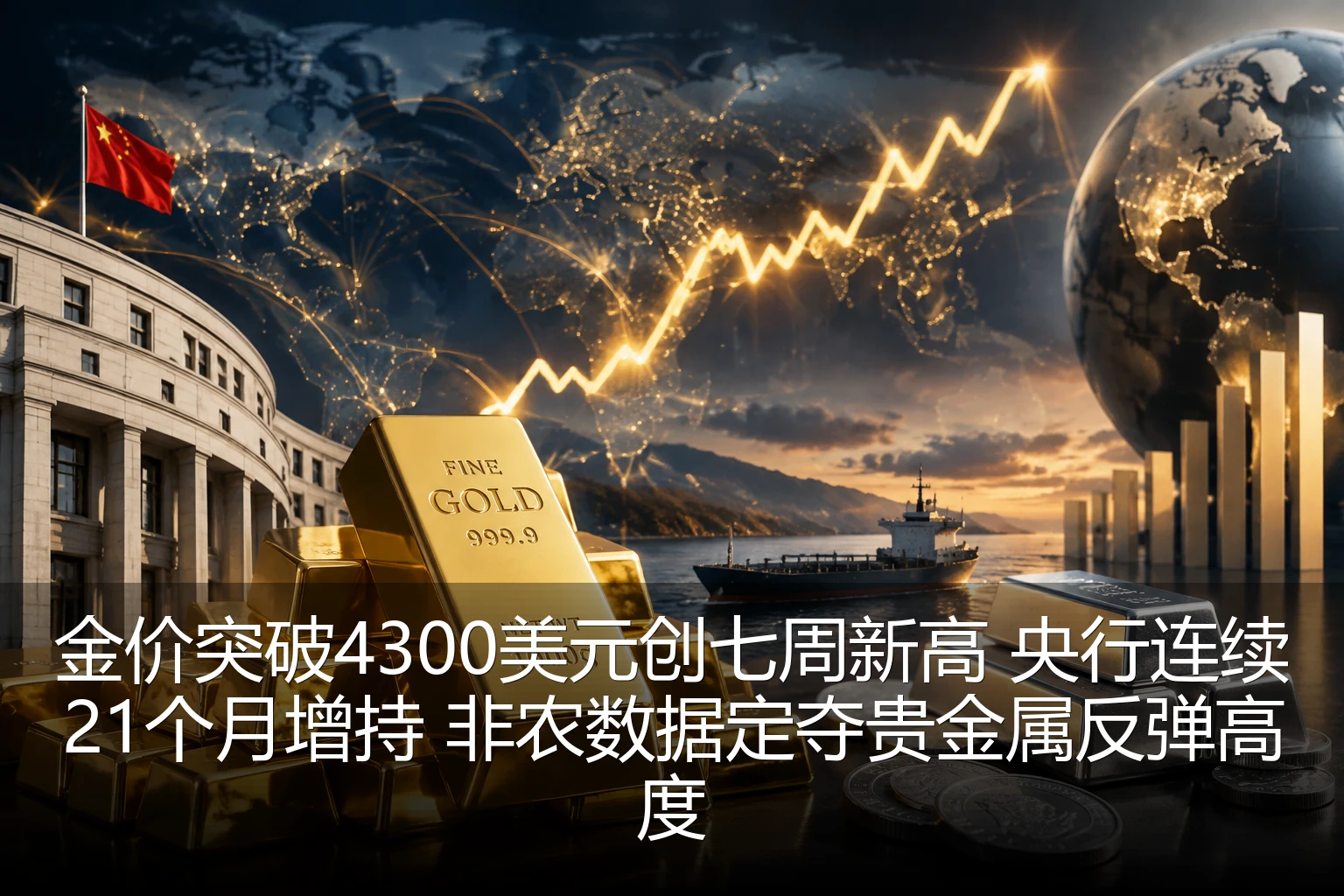
On August 7, the international precious metals market welcomed a strong rally. Spot gold broke through the $4300 per ounce mark during the session, with a daily increase of over 1.5%,刷新 the seven-week high since June 18; spot silver also rose more than 4%, standing above $64 per ounce. As of press time, London spot gold was reported above $4300, with a high of $4295, while COMEX gold futures reached a high of $4343; spot silver reached a high of $63.65, with a maximum daily increase of over 3.4%. Gold and silver rose together, with market sentiment significantly improving.
Multiple favorable factors jointly push gold and silver higher
The rapid rise in gold and silver prices this round is the result of multiple factors. First, US employment data was weaker than expected. The so-called "small non-farm" ADP data showed that US private sector employment in July only increased by 44,000, the lowest level since the beginning of the year, far below the market expectation of 75,000, and significantly lower than the revised 95,000 in June. The significant cooling of the job market significantly cooled market expectations for the Fed's September rate hike, and the US dollar index subsequently came under pressure, providing valuation repair momentum for non-interest-bearing gold.
At the same time, geopolitical risks have eased in stages. Iran stated that it has reached a temporary agreement with Oman regarding the passage of commercial vessels through the Strait of Hormuz, international oil prices fell significantly, market inflation expectations subsequently cooled, and the core factor suppressing gold prices has loosened. In addition, last week the US and Japan jointly intervened in the foreign exchange market, with market estimates that Japan sold nearly $60 billion in US Treasuries to support the yen, the US dollar index fell to a six-week low, further boosting dollar-denominated precious metals.
China's central bank increases holdings for 21 consecutive months, gold buying intensifies
At the official reserve level, the People's Bank of China updated official reserve asset data on August 7, showing that as of the end of July, China's gold reserves rose to 76.08 million ounces, an increase of 640,000 ounces from 75.44 million ounces at the end of June, with the increase larger than 480,000 ounces in June. Since starting this round of increases in November 2024, the People's Bank of China has increased gold holdings for 21 consecutive months, highlighting the increasingly important position of gold in official reserve asset allocation. At the same time, China's foreign exchange reserves at the end of July were reported at $3,418.776 billion, a slight increase from the previous value.
In fact, the pace of global central bank gold buying has never stopped. World Gold Association data shows that central banks and other official institutions worldwide net purchased 289 tons of gold in the second quarter of 2026, a year-on-year increase of 62%, with the gold buying activities of many economies clearly recovering; global central bank gold purchases in the first half reached 345 tons, still higher than the average level of the past ten years. The association's latest "Global Central Bank Gold Reserves Survey" shows that 89% of surveyed central banks expect global central bank gold reserves to continue to increase in the next 12 months, while the proportion of central banks expecting their own reserves to increase reached a record 45%, highlighting the long-term stable importance of gold in official reserves.
From safe-haven assets to strategic allocation, gold's role changes
The World Gold Association recently released a report pointing out that against the background of the acceleration of the multipolar evolution of the global political and economic landscape and the rise of resource and political nationalism, gold is undergoing a transformation from traditional "safe-haven assets" to "strategic allocation", gradually becoming the "new bottom warehouse" in asset portfolios in a multipolar era. Gold's characteristics of scarcity, indestructibility, high liquidity, and not relying on any sovereign country's issuance make it play an increasingly key role in the diversification of central bank reserves and resident wealth management.
The report also pointed out that from a long-term return perspective, the compound annual growth rate of gold prices in RMB has been about 9% in the past 20 years, exceeding the performance of domestic stocks and bonds; since the collapse of the Bretton Woods system in 1971, the annual return of gold prices in US dollars has also reached 8.8%, showing gold's stable value preservation and appreciation function in traversing multiple inflation cycles, as well as its systematic risk hedging value for stock and bond portfolios. In the process of resident department wealth shifting from low-yield deposits to the capital market, gold, with its low correlation with stocks and bonds, has become an important part of enhancing the resilience of asset portfolios.
Silver's rise is stronger, industrial attributes add color
Compared to gold, silver's gains in this round are even more dramatic. On August 7, spot silver reached a high of $63.65 per ounce during the session, and further rose above $64, with a cumulative increase of over 9% this week,刷新 a six-week high. The main silver futures contract in Shanghai also strengthened, with the morning quote of Ag(T+D) on the Shanghai Gold Exchange rising to around 15,160 yuan/kg. In the A-share market, the precious metals sector fluctuated higher in the afternoon, with Zhaojin Gold hitting the limit-up, and many concept stocks such as Shengda Resources, Yuguang Gold and Lead, Zhongjin Gold, and Hunan Silver following the rise.
Analysts pointed out that silver has both financial and industrial attributes. Against the background of the continuous expansion of demand in the photovoltaic and other green energy industries, the tight supply and demand situation provides medium and long-term support for silver prices. Coupled with the recent improvement in market risk appetite and the release of gold-silver ratio repair needs, silver's elasticity is often greater than gold, making it the leading variety in this round of precious metals market.
Jewelry prices fall at high levels, physical consumption rationally waits and sees
It is worth noting that while international gold prices rose sharply, domestic brand gold shop gold prices actually fell. After raising by 55-58 yuan/gram on the previous trading day, mainstream domestic gold shop gold jewelry prices generally lowered by 10-11 yuan/gram on August 7, ending the previous day's general rise. Calculations show that buying 50 grams of "three golds" can save about 21,000 yuan compared to previous highs, and some刚需 consumers are starting to wait for a more suitable entry window, with the inhibitory effect of high prices on terminal physical consumption becoming apparent.
Non-farm night determines direction, institutions remind of fluctuation risks
Looking ahead, the US July non-farm employment report to be released on Friday evening has become the key variable determining the height of this round of gold and silver rebound. The market generally expects about 80,000 new non-farm jobs in July, with the previous value of 57,000. If the data continues the weakness of ADP, Fed rate hike expectations will further fade, and the center of gravity of gold and silver prices is expected to continue to rise; conversely, if employment performance exceeds expectations, be alert to the risk of precious metals rising and then falling. Many institutions expect that next week, London gold will refer to the operating range of 4100-4500 US dollars/ounce, with fluctuation amplitude expected to significantly increase.
Qu Rui, senior deputy director of the Research and Development Department of Orient Gold Credit, believes that this round of rapid rise in gold prices is mainly driven by the three factors of geopolitical risk easing, US dollar weakening, and previous pessimistic pricing repair. In the short term, gold prices still have upward space, but subsequent trends highly depend on the verification of geopolitical changes, fundamental data and policy signals. From a macro perspective, the Fed's policy stance of "high interest rates maintained for longer" has not been fundamentally reversed, the market has only delayed the timing of rate hikes, and has not fully priced the rate cut cycle, real interest rates will still fluctuate at high levels, gold prices lack core support for a trend rise, and it is recommended that investors rationally view short-term fluctuations and pay attention to the performance of gold and silver prices at key levels.
Overall, under the interweaving of central bank gold buying, safe-haven demand and monetary policy expectations, the precious metals market is entering a new stage of increased fluctuations, with both opportunities and risks. For ordinary investors, the long-term allocation value of gold and silver is still prominent, but short-term trading still needs to be guided by data and policies, with good position management and risk control.