Gold Price Correction Accelerates: Major Global Banks Cut Forecasts in Unison as Banks Tighten Precious-Metals Trading Risk Controls
Keywords: gold price, major global banks, gold price forecasts, precious metals investment, margin ratio, risk management
Introduction
Recently, the gold market has once again become a global capital focus. As gold prices continue to pull back, many international investment banks have successively lowered their gold price outlooks, with Goldman Sachs cutting its year-end 2026 target price to US$4,900 per ounce, US$500 lower than before. Notably, this is the sixth major international bank to downgrade its gold outlook in recent days. In parallel, multiple domestic banks have been raising margin requirements for precious-metals trading in quick succession, and market risk-control signals are clearly strengthening.
Gold has long been viewed as an important tool for inflation protection, safe haven and asset allocation, but under the current changes in the macro environment, its pricing logic is being reshaped. Interest-rate expectations, the dollar, geopolitics and central-bank gold buying are all jointly influencing gold's medium- and long-term direction. For investors, understanding the drivers behind this correction matters far more than chasing short-term price moves.
1. Major Global Banks Turn Cautious: Why Gold Expectations Were Cut
The key reason Goldman Sachs lowered its gold target is that its view on the Fed's rate-cut pace has changed. Goldman economists have pushed back the next rate cut to 2027, which means the liquidity easing and gold inflows that the market had been hoping for may not materialize in the near term. Because gold itself does not generate interest income, weaker rate-cut expectations naturally reduce its attractiveness.
At the same time, new Fed Chair Wors released a stronger-than-expected hawkish signal, easing market concerns about the Fed's independence and, to some extent, weakening gold's appeal as a safe-haven asset. Goldman even warned that if the Fed raises rates this year, gold prices could fall to US$4,400 per ounce by year-end.
From a market timing perspective, gold had surged earlier in the year, with the main Comex gold futures contract briefly breaking above US$5,500 per ounce to hit a stage high; now prices have fallen back below the US$4,200 mark, showing that sentiment and pricing have clearly shifted.
2. From a "bullish consensus" to "cautious pricing": multiple institutions revise forecasts
Goldman is not the only institution to turn cautious. Deutsche Bank had already cut its year-end 2026 gold forecast from US$5,000/oz to US$4,800/oz; Citi lowered its three-month target from US$4,300/oz to US$4,000/oz twice in just one month; JPMorgan cut its 2026 average gold price forecast from US$5,708/oz to US$5,243/oz. Morgan Stanley and ANZ also lowered their target prices and timing.
These revisions send a common message: institutions have not completely denied gold's long-term value, but they are clearly more conservative about its short-term upside. In the past, the market generally believed gold had strong support during rate-cut cycles, rising inflation and geopolitical conflicts; now, high real rates, unstable inflation expectations and policy uncertainty have challenged gold's traditional pricing framework.
Morgan Stanley noted that geopolitical tensions have pushed real rates higher and delayed Fed cuts, changing the macro landscape. For gold, a non-interest-bearing asset, higher bond yields weaken its relative appeal, which is one of the main reasons for capital reallocation.
3. Why Gold Is Weakening: The Safe-Haven Logic Has Not Failed, the Conditions Have Changed
Gold prices are not driven by safe-haven sentiment alone, but by multiple variables. The current pressure on gold mainly comes from three sources:
First, tighter rate expectations. Market hopes for rapid Fed easing have faded, raising the opportunity cost of holding gold.
Second, the stronger dollar and higher real rates are pressing on gold prices. When real rates rise, cash-like or bond-like assets become more attractive, and gold's allocation value as a non-yielding asset declines.
Third, safe-haven demand still exists, but it is clearly more selective. Geopolitical risks remain, yet the market finds that risk events have not continued to push gold into a new one-way rally, indicating that investors are now paying more attention to policy paths and real yields rather than simply chasing safe-haven sentiment.
That said, gold has not lost all support. Goldman still stresses that the continued trend of central-bank buying will provide medium- to long-term support for the market. In other words, the long-term structural logic for gold has not been destroyed; only its short-term valuation and market expectations need recalibration.
4. Banks Raise Margin Requirements in Step: Risk Management Has Clearly Tightened
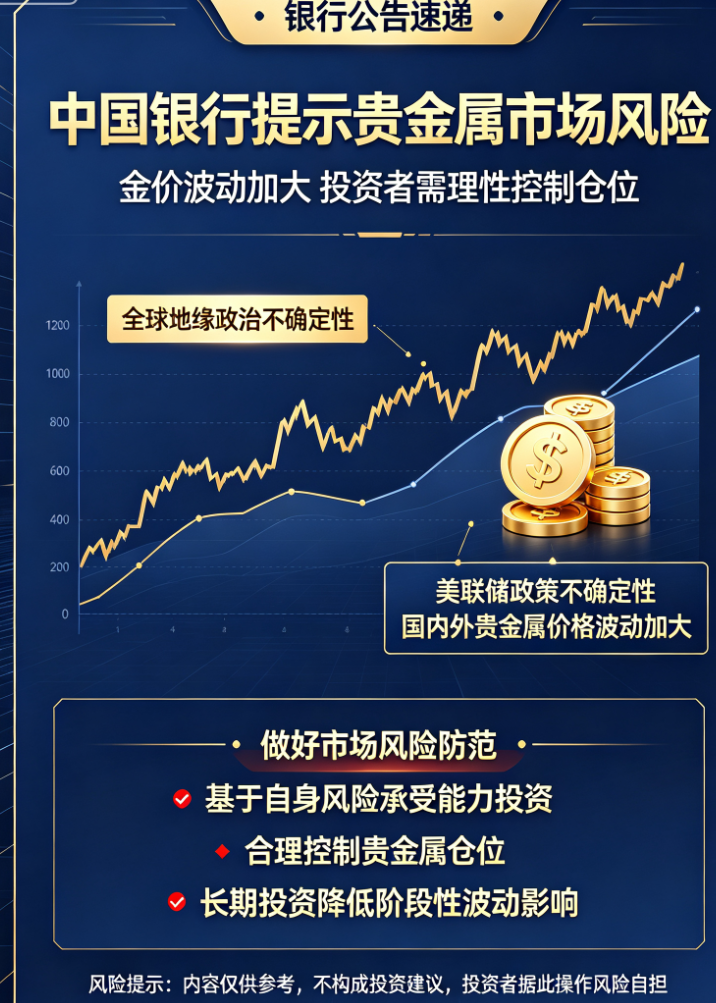
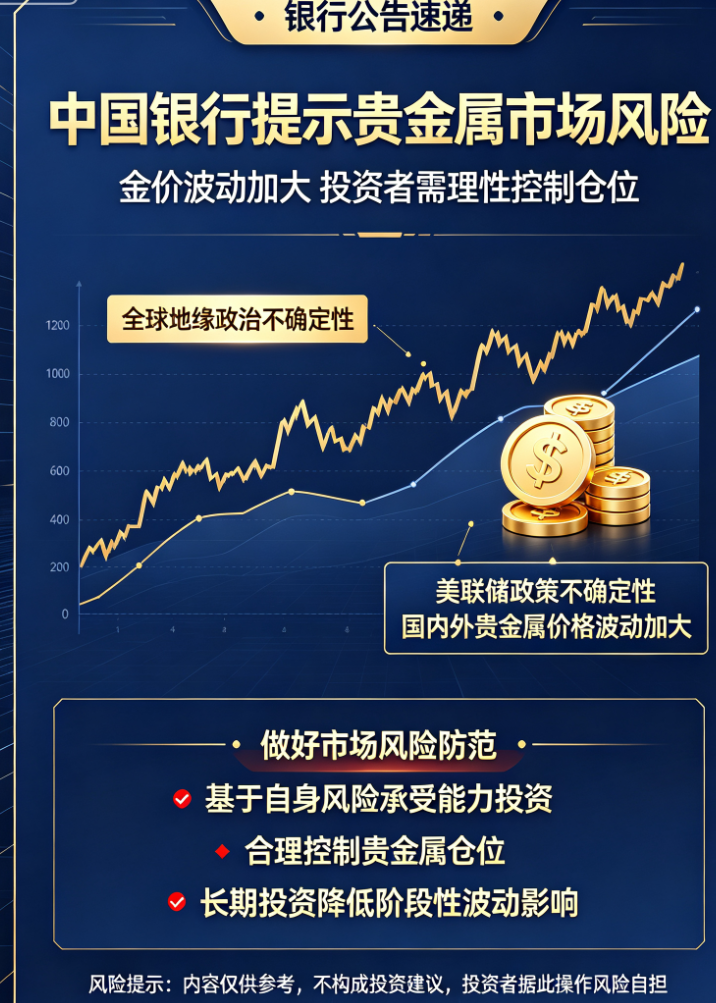
Against the backdrop of heightened volatility in international gold prices, domestic banks have also quickly tightened risk controls for related precious-metals business. Recently, China Guangfa Bank, Huaxia Bank, Agricultural Bank of China, China Construction Bank, ICBC, China Merchants Bank, and Bank of China have successively announced higher margin ratios for deferred gold and silver contracts or related precious-metals trading.
This move sends two important signals: first, banks' sensitivity to market volatility risk has risen sharply; second, precious-metals trading is shifting from a phase of "high volatility, high leverage" back toward one of "strong risk controls and prudence." For ordinary investors, higher margin ratios mean a higher entry barrier, lower leverage, and greater account volatility. Without sufficient position management and risk tolerance, it is easy to face forced liquidation during sharp short-term swings.
From a regulatory and institutional risk-control perspective, this adjustment is necessary and timely. When gold prices pull back rapidly, funds that chased the rally earlier may face sizable unrealized losses; if margin requirements are not adjusted in time, systemic risk will continue to build. By raising margin ratios, banks are essentially cooling the market.
5. How Should Investors Respond? Return to Rational Allocation
Faced with gold price volatility and institutions revising forecasts in unison, investors should avoid treating gold as a one-way asset that only rises. Gold is better seen as a portfolio stabilizer rather than a short-term trading tool.
For conservative investors, the following points matter most:
- Control position size and avoid chasing highs or selling lows blindly. Gold should be allocated in a diversified, staged manner rather than in one large chunk at an emotional peak.
- Distinguish between investing and speculation. Physical gold, gold ETFs and deferred contracts carry very different risk profiles, so choose tools according to your own goals.
- Watch macro variables. Fed policy, real interest rates, the dollar and central-bank gold buying are key to judging the gold price trend.
- Pay attention to risk warnings. Frequent increases in margin requirements by banks are themselves important market warning signals, and investors should adjust their strategies promptly.
Over a longer horizon, gold still has allocation value, especially in an environment of high global uncertainty and repeated policy swings. Gold remains an important risk-hedging tool. But that does not mean prices can keep rising indefinitely regardless of valuation and policy constraints. The market is shifting from sentiment-driven to fundamentals-driven pricing, which is the core logic behind the current correction.
Conclusion
Overall, this round of gold correction is no accident; it is the result of changing rate expectations, policy paths and risk appetite. The concentrated cuts in price forecasts by international banks show that institutions have become cautious about gold's near-term outlook, while domestic banks raising margin requirements further indicate that volatility risk in the precious-metals market is rising.
Over the next period, gold prices will likely continue to fluctuate around expectations for Fed policy, global real interest rate levels and changes in geopolitical conditions. For investors, the truly effective response is not to chase short-term swings, but to maintain rational judgment, control risk and optimize allocation. As gold shifts from a "hot trade" back to a "value allocation," calmness and discipline may matter more than directional calls.