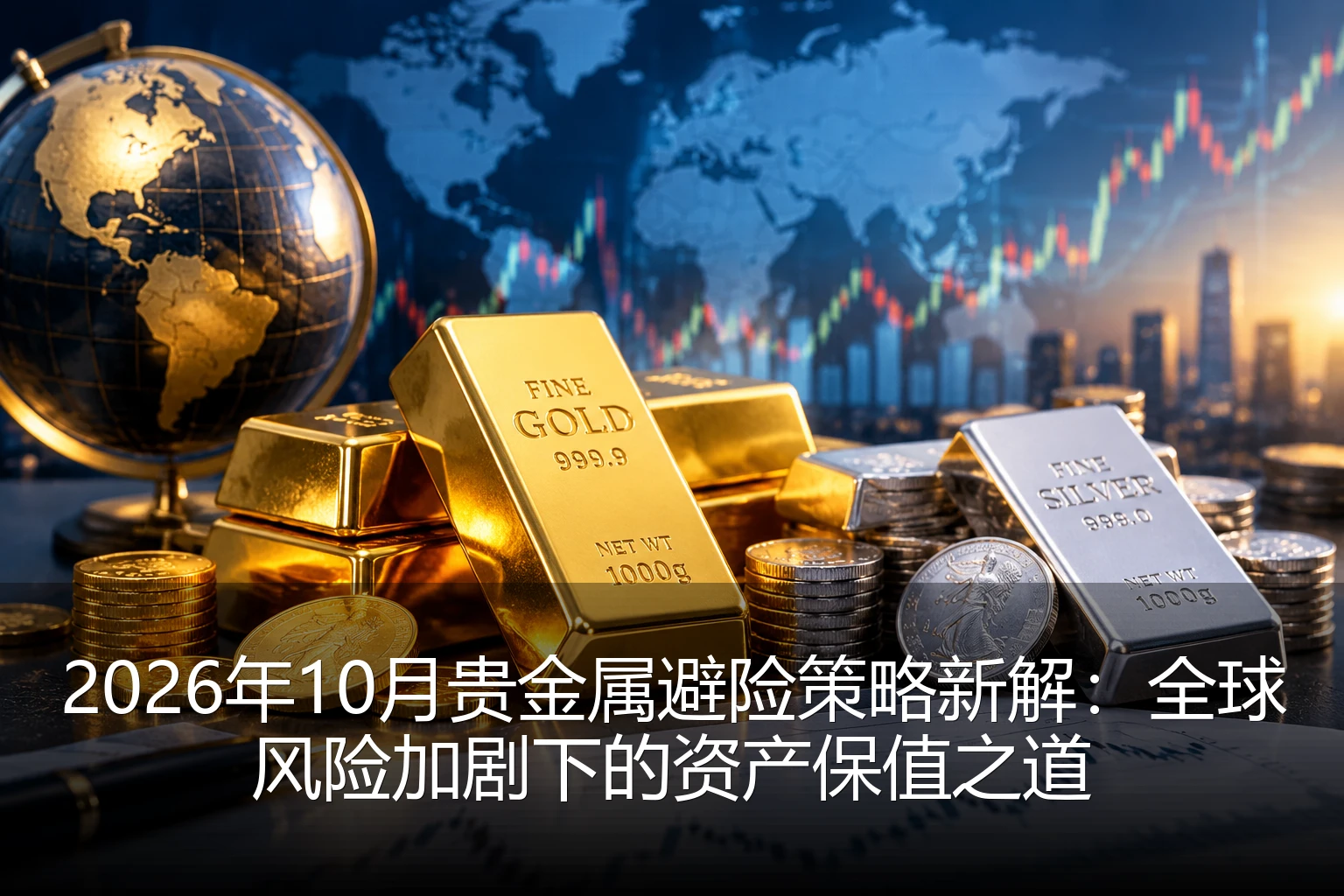
Against the backdrop of increasing global economic uncertainty, precious metals as traditional safe-haven assets have once again become the focus of investor attention. In 2026, facing complex international situations, inflationary pressures, and financial market volatility, precious metal hedging strategies have become particularly important. This article will provide an in-depth analysis of the current economic situation, explore the historical performance of precious metal hedging, and offer practical hedging allocation strategies to help investors protect asset value in volatile markets.
\n\nGlobal Economic Uncertainty Intensifies, Driving Demand for Safe Havens
\n\nIn 2026, the global economy faces multiple challenges, with geopolitical tensions continuing to escalate, major economies experiencing slower growth, and inflationary pressures showing signs of relief but remaining above target levels. Against this backdrop, investor demand for safe assets has significantly increased, with precious metals like gold and silver once again being favored as traditional hedging tools.
\n\nGeopolitically, the ongoing Russia-Ukraine conflict continues to impact global energy and food supply chains, while tensions in the Middle East have heightened market uncertainty. Economically, US growth has slowed, Europe has entered a technical recession, and China's economic transformation faces challenges. In financial markets, increased stock market volatility, an inverted yield curve, and other factors have heightened investor risk aversion.
\n\nAccording to the latest report from the International Monetary Fund (IMF), global economic growth expectations for 2026 have been revised down to 3.2%, 0.5 percentage points lower than initial forecasts. Meanwhile, global total debt has exceeded $340 trillion, a historic high, making debt risks impossible to ignore. In this macroeconomic environment, the value of precious metals as safe-haven assets has become even more prominent.
\n\nHistorical Performance and Theoretical Foundations of Precious Metal Hedging
\n\nHistorical data shows that precious metals, particularly gold, tend to perform well during periods of economic uncertainty. Looking back at market performance over the past few decades, we can identify several key periods where precious metals demonstrated their hedging characteristics:
\n\n- \n
- During the 2008 financial crisis, gold prices rose from around $800 to over $1,900, an increase of more than 130% \n
- During the 2020 COVID-19 pandemic, gold broke through the $2,000 mark, reaching an all-time high \n
- Following the outbreak of the Russia-Ukraine conflict in 2022, gold prices surged rapidly, setting new records \n
The theoretical foundations of precious metal hedging primarily stem from their unique properties. First, precious metals are scarce, with a limited total supply of gold that cannot be easily increased artificially, making them an effective tool against inflation. Second, precious metals have low correlation with most traditional asset classes, enabling effective diversification of portfolio risk. Additionally, precious metals are widely accepted globally, possessing high liquidity and market recognition.
\n\nResearch by the World Gold Council (WGC) shows that allocating 5-10% of a portfolio to gold can significantly reduce portfolio volatility while improving risk-adjusted returns. This "gold effect" is particularly pronounced during market turmoil, providing valuable downside protection for investors.
\n\nSpecific Recommendations for Precious Metal Hedging Strategies in 2026
\n\nFacing the current complex market environment, investors need to develop scientific precious metal hedging strategies. The following are specific recommendations for 2026:
\n\n1. Rational Allocation Proportions
\n\nDepending on investors' risk tolerance and investment objectives, the allocation proportion of precious metals in investment portfolios should vary. Conservative investors may consider allocating 15-20% to precious metals, balanced investors 10-15%, while aggressive investors can allocate 5-10%. This allocation ratio should be dynamically adjusted based on market conditions, appropriately increasing precious metal proportions when economic uncertainty increases.
\n\n2. Diversified Precious Metal Allocation
\n\nIn addition to gold, silver, platinum, and palladium also have important hedging value. Silver combines both industrial and hedging attributes, performing well when inflation is high and industrial demand is strong; platinum and palladium benefit from the green energy transition with promising long-term prospects. Investors can construct diversified precious metal portfolios based on the characteristics and market performance of different precious metals.
\n\n3. Timing of Allocation
\n\nFluctuations in precious metal prices provide investors with allocation opportunities. Combining technical analysis with fundamental analysis can help investors identify favorable entry points. Generally, precious metals tend to perform well when real interest rates (nominal rates minus inflation) are negative; the escalation of geopolitical tensions is also a good time to increase precious metal allocations.
\n\n4. Diversified Investment Methods
\n\nInvestors can participate in the precious metals market through various methods, including physical gold (gold bars, coins), gold ETFs, gold futures, and gold stocks. Different investment methods have their own advantages and disadvantages: physical gold provides direct ownership but has higher storage costs; ETFs are convenient to trade but require management fees; futures and leveraged products carry higher risks and are suitable for professional investors. Investors should choose appropriate investment methods based on their own needs.
\n\nHedging Allocation Plans for Different Investor Types
\n\n1. Institutional Investors
\n\nFor institutional investors such as pension funds and insurance companies, precious metals can serve as an important component of long-term asset allocation. It is recommended to allocate 5-10% of assets to precious metals, with 60-70% allocated to gold, 20-30% to silver, and the remaining portion to platinum and palladium. Institutional investors can also consider hedging through precious metal futures and options to reduce the overall risk of their investment portfolios.
\n\n2. High-Net-Worth Individuals
\n\nHigh-net-worth investors can adopt a "core-satellite" strategy, allocating most of their assets (70-80%) to traditional asset classes such as stocks, bonds, and real estate, with 20-30% as satellite allocation, of which 5-10% is allocated to precious metals. High-net-worth investors can also consider allocating a certain proportion of physical gold as an emergency reserve to respond to extreme market conditions.
\n\n3. Ordinary Investors
\n\nFor ordinary investors, participation in the precious metals market can be achieved through gold ETFs and precious metal thematic funds. It is recommended to allocate 5-10% of the investment portfolio to precious metals, focusing on investment products with good liquidity and low fees. The regular fixed-investment strategy is suitable for ordinary investors, as it can smooth price fluctuations and reduce timing risks.
\n\nFuture Outlook for the Precious Metals Market and Long-Term Allocation Value
\n\nLooking ahead, the precious metals market faces multiple opportunities and challenges. In terms of opportunities, global central banks continue to increase their gold reserves, with global central bank gold purchases growing by 15% year-on-year in the first half of 2026, a historic high. Meanwhile, the trend of diversification of foreign exchange reserves in emerging market countries is evident, with the share of gold in official reserves continuing to rise.
\n\nIn terms of challenges, as the global economy gradually recovers, central banks may begin to tighten monetary policy, which will put pressure on precious metal prices. Additionally, the rise of digital currencies may also pose challenges to the traditional safe-haven status of precious metals.
\n\nNevertheless, in the long run, the core status of precious metals as safe-haven assets will not change. The World Gold Council predicts that by 2030, gold's share in global central bank reserves may reach 15-20%, an increase from the current approximately 13%. At the same time, as global debt levels continue to rise and geopolitical risks intensify, the demand for precious metals as safe havens is expected to remain strong.
\n\nConclusion
\n\nIn the uncertain global economic environment of 2026, the importance of precious metals as safe-haven assets has become even more prominent. Through scientific allocation strategies, investors can effectively utilize the hedging characteristics of precious metals to protect asset value and achieve steady growth of investment portfolios. Whether institutional investors, high-net-worth individuals, or ordinary investors, they should develop appropriate precious metal hedging strategies based on their own circumstances to respond to the increasingly complex market environment.
\n\nPrecious metal hedging is not only an investment strategy but also a risk management tool. Against the backdrop of multiple challenges facing the global economy, rational allocation of precious metals will provide investors with valuable downside protection, helping them achieve asset preservation and appreciation in volatile markets. With changes in the global economic landscape and development of financial markets, precious metal hedging strategies will continue to innovate and improve, providing investors with more diversified choices.