Gold Market New Shift: Short-Term Pressure and a Fresh Look at Long-Term Value
Keywords: gold market; stronger dollar; rate-hike expectations; central bank reserves; safe-haven asset; investment strategy
Introduction: Signs of a Bull Market Turning Point
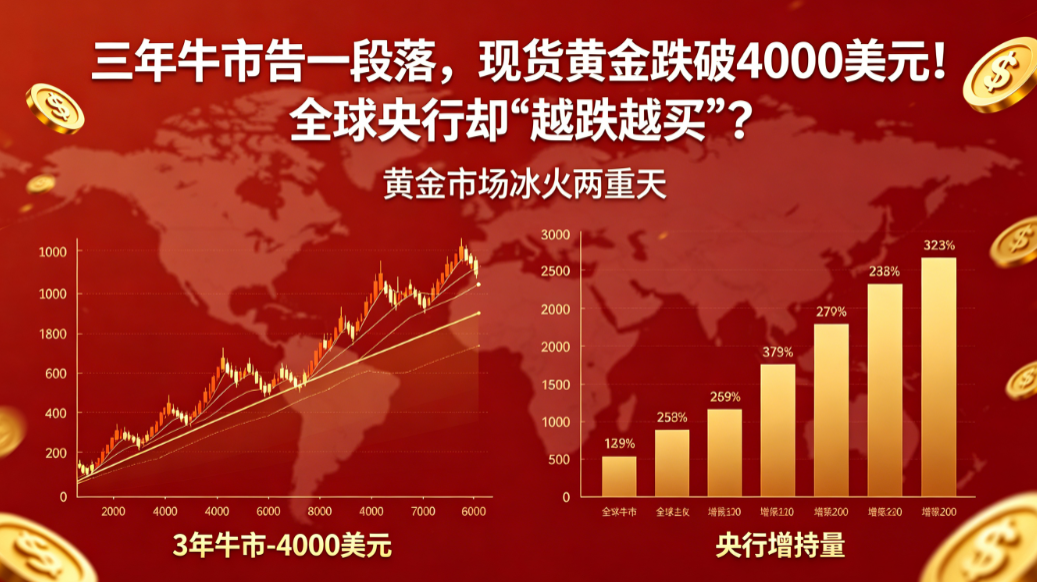
After a three-year bull run, the gold market has recently reached a key turning point. As the dollar index keeps strengthening and the market's expectations for a Fed rate hike rise sharply, gold has fallen below $4,000/oz for the first time since last November. At the latest close, spot gold was down 2.73% from the previous trading day, ending at $3,998.98/oz, a level that marks a significant retreat from the high range. Spot silver was not spared either, plunging 6.8% to $57.42/oz. Yet behind the short-term price pressure, central banks around the world have not lost their appetite for gold. The latest World Gold Council survey reveals a much more complex market picture. This article will interpret current gold-market dynamics from three angles: short-term market drivers, structural changes in central bank reserves, and gold's long-term investment logic.
1. Short-Term Adjustment Pressure: The Double Drag of the Dollar and Rates
1.1 The Resonance of a Stronger Dollar and Rate-Hike Expectations
The current downside pressure on gold prices mainly comes from sharp changes in the macro-financial environment. As the world's main pricing currency, the dollar has a decisive impact on gold, which is denominated in dollars. Recently, U.S. economic data have shown strong resilience, the labor market remains tight, and core inflation is falling more slowly than expected. These factors together are causing market participants to reassess the Fed's policy path. The dollar index has risen accordingly, putting direct valuation pressure on gold.
More importantly, expectations of a Fed rate hike are rising noticeably. With inflation still above target, Fed officials have repeatedly sent "higher for longer" signals, suggesting the rate peak may be higher than previously expected and that the high-rate environment will last longer. That is a double blow for gold: on one hand, higher rates raise the opportunity cost of holding non-yielding gold; on the other, a strong dollar weakens gold's appeal as an alternative currency. This combined pressure from rates and exchange rates has fueled the sharpest sell-off since last November.
1.2 The Convergence of Technical Selling and Market Sentiment
Once gold fell below the key psychological level of $4,000, technical selling accelerated and pushed prices lower still. In financial markets, the loss of a key round number often triggers program trading and stop-loss orders, creating a negative feedback loop of "drop-sell-drop again." A look at market microstructure shows that gold futures and ETF holdings have both declined noticeably over the past few trading days, indicating that some speculative longs are exiting.
However, it is worth noting that this price adjustment driven by macro expectation changes is more of a correction to earlier excessive optimism than a fundamental change in gold's underlying logic. Historically, gold often comes under pressure early in a rate-hike cycle, but as markets digest the rate environment and inflation expectations evolve, gold may regain upward momentum.
2. The Deeper Logic of Central Bank Gold Buying: Structural Demand Support
2.1 Positive Signals from the Central Bank Gold Reserve Survey
At a time when gold prices are under pressure, the World Gold Council's latest annual survey of central bank gold reserves gives the market an important reference point. The survey shows that 89% of reserve managers expect global central bank gold holdings to keep rising over the next 12 months. This is highly persuasive, as it reflects the judgment of some of the world's most cautious and professional asset managers on gold's value.
Even more strikingly, gold has overtaken U.S. government bonds as the preferred reserve asset in central bank portfolios. This structural shift is significant: historically, Treasuries were seen as the world's most important reserve asset thanks to unmatched liquidity and safety. But in recent years, geopolitical risks, disputes over the U.S. debt ceiling, and concerns about the dollar's credit have pushed central banks to diversify reserves. As an asset with no sovereign risk, gold naturally becomes the alternative.
2.2 A Quantitative View of Reserve-Building Plans
The survey also reveals concrete plans to add to reserves: as many as 45% of reserve managers said they expect their institutions to increase gold holdings in the next 12 months, a record high far above recent years. Even more notable is the long-term outlook: 83% of respondents believe gold's share of total reserves will be higher five years from now, up from 76% last year, showing that central banks' bullish view of gold is strengthening.
Behind these numbers is a deep recognition of changes in the international monetary system. As global geopolitical uncertainty rises and some countries push de-dollarization, gold is not just an investment asset but also a strategic reserve tool. Central banks in emerging and developing economies, especially those facing Western sanctions risks, are accelerating gold purchases. For example, China's central bank has been adding gold for many consecutive months, and central banks in Poland and Uzbekistan have also joined the buying wave. This official-sector demand is highly certain and durable.
3. Long-Term Investment Logic: A Certain Choice in an Uncertain Era
3.1 Gold's Essential Nature as a Safe-Haven Asset
Amid the noise of short-term price swings, we need to return to gold's essential nature. Gold is the oldest form of money in human history, and its core value lies in being hard to counterfeit, durable, divisible, and limited in supply. Even within the world's largest sovereign credit-money system, gold still plays the role of the "ultimate money." When confidence in fiat currency systems erodes, gold's value becomes more visible.
Today, the global economy faces multiple uncertainties: recurring geopolitical conflicts, slow supply-chain restructuring, and high debt levels in major economies. In this context, gold's function as a safe haven and inflation hedge has not been weakened by short-term price declines. Relevant institutions point out that the long-term investment logic for gold has not changed in any fundamental way, and its portfolio value remains prominent amid rising global uncertainty.
3.2 Weaker Dollar Credit and Gold's Medium- to Long-Term Outlook
Institutional analysis suggests that the current inflation-pricing environment may keep interest rates elevated, making bond markets themselves relatively fragile. More importantly, some countries are reducing their purchases of U.S. Treasuries, which means that once the Fed scales back bond buying, U.S. fiscal funding costs may come under upward pressure. This mechanism will ultimately weaken dollar credit and provide structural support for gold's medium- to long-term rise.
Historically, the dollar credit cycle and gold prices have shown a pronounced negative correlation. When confidence in the dollar falters, funds flow into hard assets such as gold. Today, the continued rise in U.S. debt relative to GDP and the repeated political battles over the debt ceiling are eroding the dollar's international reputation. Although this process is gradual, its direction is clear. Therefore, institutions judge that short-term gold prices may continue to adjust on inflation expectations, but the medium- to long-term bullish view remains unchanged, and a new all-time high is still likely.
3.3 Investment Strategy: The Wisdom of Buying in Batches on Dips
Based on the analysis above, the right investment strategy at current price levels matters greatly for ordinary investors. Institutions recommend buying in batches on dips to capture long-term opportunities. Specifically, investors can deploy funds gradually when the market pulls back rather than investing all at once. This approach helps reduce timing risk and smooth out entry costs.
At the same time, investors should remain patient. Historically, gold bull markets are often accompanied by rising economic uncertainty and turmoil in credit systems. While gold prices may continue to face short-term pressure, the core forces affecting gold in the long run—global de-dollarization, central bank reserve accumulation, and inflation expectations—have not fundamentally changed. Current levels may be a suitable time to build a strategic gold allocation rather than a moment to panic out.
Conclusion: Short-Term Correction Does Not Change the Long-Term Trend
In summary, the current short-term adjustment in the gold market is mainly driven by a stronger dollar and rising rate-hike expectations, and is essentially a technical pullback at the market level. However, judging from the continued reserve accumulation by central banks worldwide, gold's status as a strategic asset is rising steadily. Against the backdrop of weakening dollar credit, rising geopolitical risks, and growing global economic uncertainty, gold's long-term investment value remains solid. For rational investors, short-term price swings should not obscure gold's importance in medium- to long-term allocation. Buying on dips and holding patiently may be the most reasonable strategy at present. The gold bull market may be taking a "halftime break," but the next upswing could be just around the corner.