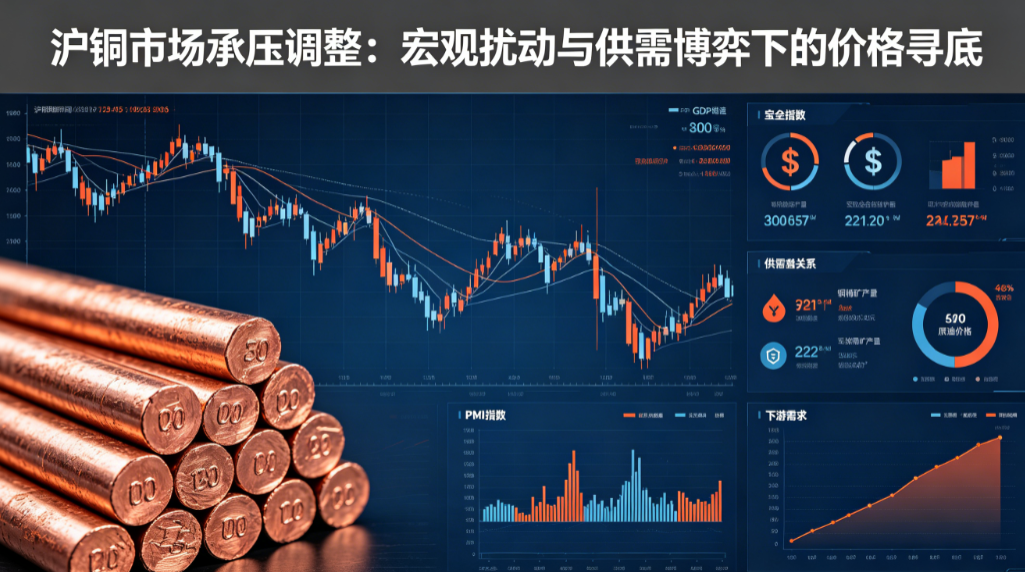
Shanghai Copper Under Pressure: Price Bottoming Amid Macro Shocks and Supply-Demand Tug-of-War
Keywords: Shanghai copper, copper prices, macro pressure, supply-demand balance, inventory changes, investment strategy
1. Introduction
Recently, Shanghai copper has gone through a notable correction. As of the latest trading day, the average spot price of SMM No. 1 electrolytic copper stood at 104,170 yuan/ton, with a discount of 10 yuan/ton. In the futures market, the night session of the Shanghai copper 2608 contract closed at 102,990 yuan/ton, down 1.13%, while the LME copper 03 contract also fell 2.18% to $13,373.5/ton. After a strong earlier advance, copper prices are now facing both macro and industry-level pressure. Investors need to dig into the market's core contradictions to grasp the path ahead.
2. Market Review: Linked Declines at Home and Abroad
From a pricing perspective, the main Shanghai copper contract has repeatedly tested support near the key 103,000 yuan/ton level, while LME copper has lost the $13,500 mark, showing a pattern of relative weakness at home and strength abroad. On the spot side, the discount structure reflects weak downstream buying, and the premium/discount structure shows short-term supply-demand looseness. On exchange inventories, SHFE copper warrants fell by 2,769 tons to 75,080 tons, and LME inventories fell by 4,300 tons to 344,925 tons. Even so, total inventories across the three major exchanges still stand at 1.0877 million tons, with an inventory-to-consumption ratio above 4.0%, keeping overall inventory levels historically high and continuing to pressure prices.
3. Macro Analysis: Dollar Rebound and Cooling Risk Appetite
On the macro side, U.S. and European equities both closed lower, tech stocks took a heavy hit, and market risk appetite cooled sharply. The preliminary June S&P Global U.S. manufacturing PMI jumped to 55.7, the highest since May 2022. The services PMI rose to 51.3, and the composite PMI reached 52.2, all at multi-month highs. Stronger-than-expected economic data have reignited expectations that the Fed may raise rates again. Business inventory purchases hit a historical second-highest level, while factory employment fell to a six-year low, deepening the policy dilemma created by strong production and weak employment.
The dollar index rebounded to new highs on rate-hike expectations, directly pressuring dollar-denominated copper prices. History suggests that copper prices and the dollar usually move inversely; a stronger dollar raises copper's holding cost and forces speculative longs to unwind. In addition, the final plan for U.S. copper import tariffs from the Commerce Department is approaching, and concerns over trade policy uncertainty are dampening willingness to build long positions.
4. Supply and Demand: Surplus Continues, Smelting Margins Under Pressure
Latest data from the International Copper Study Group (ICSG) show that global copper concentrate output rose by only 13,000 tons year on year in January-March 2026, while refined copper output increased by 116,000 tons and consumption fell by 2,000 tons, leaving the global refined copper market with a surplus of 310,000 tons. This confirms the short-term oversupply pattern in copper, especially in refined copper. Slow mine growth and expanding smelting output are mismatched, but weak end demand has masked the impact of mine tightness.
Looking at processing fees and profit indicators, the weekly TC (treatment charge) has fallen to -120.82 dollars/ton, down another 0.98 dollars/ton week on week, showing that copper concentrate supply is extremely tight. The average sulfuric acid price stood at 1,628 yuan/ton, slightly lower. Based on long-term contract TC, copper smelters still have a profit of 1,970 yuan/ton, but spot-TC smelting is deeply loss-making at -2,438 yuan/ton. Industry profits are concentrated in top-tier firms with long-term contract supply, while smaller smelters are under pressure to cut output. This profit split will limit further expansion in refined copper output and offer some medium-term support to prices.
5. Inventories: Early Signs of Destocking, But the Total Is Still High
Total inventories across the three major global exchanges (SHFE, LME, COMEX) fell by 54,700 tons week on week to 1.0877 million tons, showing signs of destocking. Among them, LME inventories fell by 4,300 tons to 344,925 tons, and SHFE warrants dropped by 2,769 tons. Although the declines are not large, they have stopped the earlier buildup trend. The inventory-to-consumption ratio is above 4.0%, at a historically mid-to-high level. If destocking continues, supply pressure will gradually ease. However, domestic social inventories remain high, downstream demand has not clearly recovered, and more data are needed to confirm a turning point.
6. Investment Strategy and Outlook: Wait for Tariffs, Focus on Demand-Driven Operations
In summary, copper prices are under multiple pressures: at the macro level, a strong dollar and rate-hike expectations are suppressing risk-asset valuations; at the industry level, oversupply of refined copper and elevated inventories mean the supply-demand contradiction has not improved materially. The 2608 Shanghai copper contract is testing support at 103,000 yuan/ton, and if it breaks lower, it may continue toward the 100,000 yuan round number.
On the strategy side, since the U.S. Commerce Department's copper import tariff policy is about to be announced and uncertainty is high, investors are advised to buy only as needed and remain cautious, avoiding heavy bets before the policy lands. In the short term, watch whether the 103,000 yuan support holds. If prices stabilize and macro sentiment improves, there may be an oversold rebound; otherwise, watch for downside break risk. For hedging firms, futures tools can be used to lock in production margins and reduce price volatility risk.
7. Conclusion
Shanghai copper is at a critical stage where macro pressure and supply-demand contradictions are resonating. Strong U.S. data and the resulting rate-hike expectations, a rebounding dollar, and selling in tech stocks are all weighing on copper prices, while oversupply of refined copper, split smelting margins, and slow inventory drawdowns keep prices under pressure. Looking ahead, tariff policy, Fed signals, and the global manufacturing recovery pace will determine the direction of copper. Until uncertainty fades, staying cautious, controlling positions, and responding flexibly remain the best strategy.