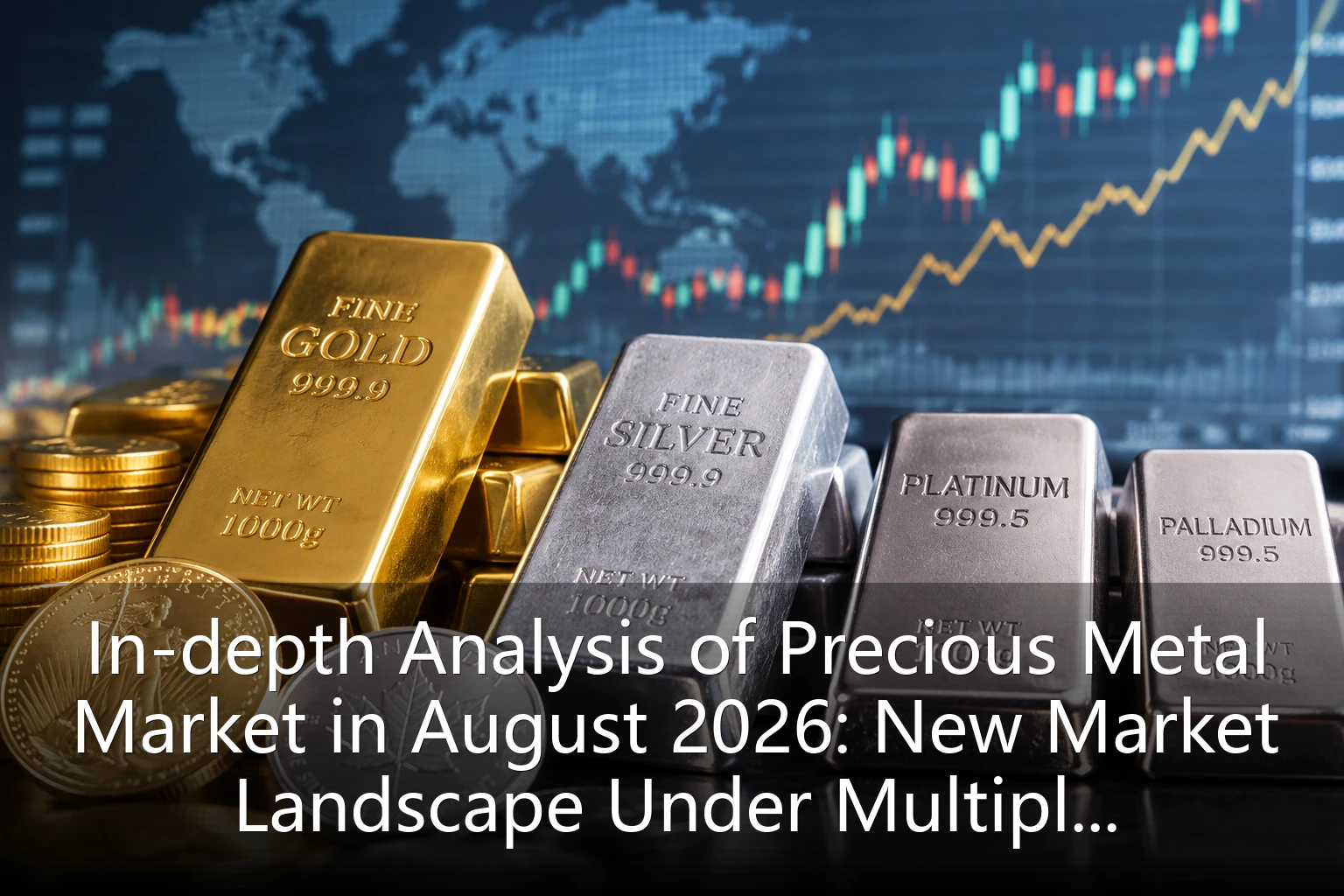
In-depth Analysis of Precious Metal Market in August 2026: New Market Landscape Under Multiple Interwoven Factors
In August 2026, the global precious metal market exhibited complex and diverse trends. Under the influence of multiple interwoven factors, major precious metal varieties such as gold, silver, platinum, and palladium showed distinct market characteristics. This article will conduct an in-depth analysis of the latest dynamics in the current precious metal market, explore key factors affecting price trends, and provide forward-looking market interpretations and investment strategy recommendations for investors.
I. Gold Market: Dual Drivers of Safe-Haven Demand and Policy Expectations
As a traditional safe-haven asset, gold continued to demonstrate its unique investment value in August 2026. Currently, gold prices showed a strong upward momentum driven by multiple factors. On one hand, escalating global geopolitical tensions, especially the escalation of conflicts in the Middle East, kept safe-haven demand rising. On the other hand, expectations of monetary policy shifts by major central banks also supported gold prices.
From a technical perspective, gold prices broke through key resistance levels in August, showing strong upward momentum. Market analysts generally believe that the long-term allocation value of gold is being re-evaluated. As global central banks accelerate the diversification of foreign exchange reserves, gold's share reached a near 30-year high, providing solid support for gold prices.
Notably, gold ETF holdings hit a three-month high in August, with institutional investors actively positioning in the gold market. The strengthening of this institutional buying further reinforced the upward trend of gold. Meanwhile, the total global debt exceeded $340 trillion, leading to a market re-evaluation of precious metals' safe-haven value, and many institutions have raised their gold target prices to $3,000.
II. Silver Market: Dual Game of Industrial Demand and Safe-Haven Sentiment
Compared to gold, the silver market showed a more complex trend in August. Silver possesses both the attributes of an industrial metal and the safe-haven function of a precious metal, and this dual nature makes its price movements subject to multiple factors.
In terms of industrial demand, as the global economic recovery progresses, the demand for silver in sectors like electronics and photovoltaics continues to grow. Especially against the backdrop of the green energy transition, silver's industrial demand is expected to increase further. However, concerns about the slowdown in global economic growth also somewhat suppressed industrial demand.
In terms of safe-haven sentiment, the correlation between silver and gold remains significant. When market safe-haven sentiment rises, silver often follows gold's upward movement. However, in some cases, silver's industrial nature can cause its performance to diverge from gold. In August, silver prices rose in a volatile manner, showing strong resilience.
From a technical analysis perspective, silver prices broke through important resistance levels in August, but changes in the gold-silver ratio deserve attention. Currently, the gold-silver ratio is at a historically low level, which may mean that silver's valuation relative to gold is already undervalued, with potential for catch-up growth in the future.
III. Platinum Market: Expanding Supply-Demand Gap and Green Energy Transition Catalysis
The platinum market performed excellently in August, with prices hitting historical highs. This trend was mainly driven by the dual forces of supply-demand fundamentals and the green energy transition.
From the supply side, production issues in major producing regions like South Africa continued to exist, leading to tight platinum supply. Meanwhile, demand for platinum from the automotive industry remained stable, especially in the European market, where the demand for platinum in automotive catalysts continued to grow as emission standards were tightened.
More importantly, the green energy transition has brought new growth momentum to the platinum market. In the hydrogen economy, platinum, as a key material for fuel cells, has broad demand prospects. As countries increase their investment in hydrogen technology, platinum demand is expected to rise further.
Market analysts point out that the expansion of the platinum supply-demand gap is the core factor driving its price increase. It is expected that in the coming years, as the hydrogen economy develops, the platinum market will maintain a supply-demand imbalance, and prices are likely to continue rising.
IV. Palladium Market: Automotive Industry Demand and Geopolitical Influence
The palladium market also showed a strong upward trend in August, mainly affected by automotive industry demand and geopolitical factors.
Palladium is mainly used in automotive catalysts. As global automobile production recovers, especially with the growth of electric and hybrid vehicles, demand for palladium continues to increase. However, supply uncertainty from Russia, a major producing region, puts upward pressure on palladium prices.
Geopolitical factors have a particularly significant impact on the palladium market. As international tensions escalate, the value of palladium as a strategic resource is being rerecognized. Market participants, worried about supply disruptions, have increased palladium reserves, further pushing up prices.
From a technical perspective, palladium prices broke through important resistance levels in August, showing strong upward momentum. Analysts believe that palladium prices still have room for further upward movement, but attention should be paid to changes in automotive industry demand and developments in geopolitical situations.
V. In-depth Analysis of Market Drivers
The trend of the precious metal market in August 2026 was influenced by multiple factors, mainly including the following aspects:
- Geopolitical Risks: Events such as the escalation of conflicts in the Middle East and tensions between Russia and the West have raised market safe-haven sentiment, pushing up precious metal prices.
- Monetary Policy Expectations: Expectations of monetary policy shifts by major central banks, especially potential interest rate cuts by the Federal Reserve, have a significant impact on precious metal prices.
- Economic Data Performance: The performance of global economic data, especially economic indicators of major economies like the United States, affects market expectations of economic prospects, thereby influencing precious metal prices.
- Supply-Demand Fundamentals: The supply-demand balance of precious metals, especially the supply-demand gaps of platinum and palladium, directly affects price trends.
- Technical Factors: Market technical patterns, capital flows, and other factors also influence the short-term trends of precious metal prices to some extent.
VI. Investment Strategies and Outlook
Facing the complex and volatile precious metal market in August 2026, investors need to adopt cautious and flexible investment strategies. Here are some key investment recommendations:
- Long-Term Allocation Value: Against the backdrop of increasing global uncertainty, the value of precious metals as safe-haven assets is highlighted. It is recommended that investors maintain a certain proportion of long-term allocation.
- Diversified Investment: Different precious metal varieties have different attributes and drivers. Investors are advised to diversify their investments to reduce risks from a single variety.
- Focus on Fundamentals: Investors should closely monitor the supply-demand fundamentals of precious metals, especially the supply-demand changes of platinum and palladium, as these factors have a more direct impact on price trends.
- Technical Analysis as an Aid: Combine technical analysis to grasp market trends and key points, improving the accuracy of investment decisions.
- Risk Management: The precious metal market is highly volatile. Investors should practice risk management, set stop-loss levels, and control positions.
Looking ahead, the precious metal market will still be influenced by multiple factors. Against the backdrop of increasing global economic uncertainty and persistent geopolitical risks, the value of precious metals as safe-haven assets is expected to be further enhanced. Meanwhile, the green energy transition will bring new growth momentum to the platinum and palladium markets. Investors should closely monitor market dynamics, flexibly adjust investment strategies, and seize investment opportunities in the precious metal market.
In summary, the precious metal market in August 2026 showed complex and diverse trends, with gold, silver, platinum, and palladium each having their unique market characteristics and drivers. Investors need to fully understand market dynamics, combine their own risk preferences and investment goals, and formulate appropriate investment strategies to cope with market changes and challenges.