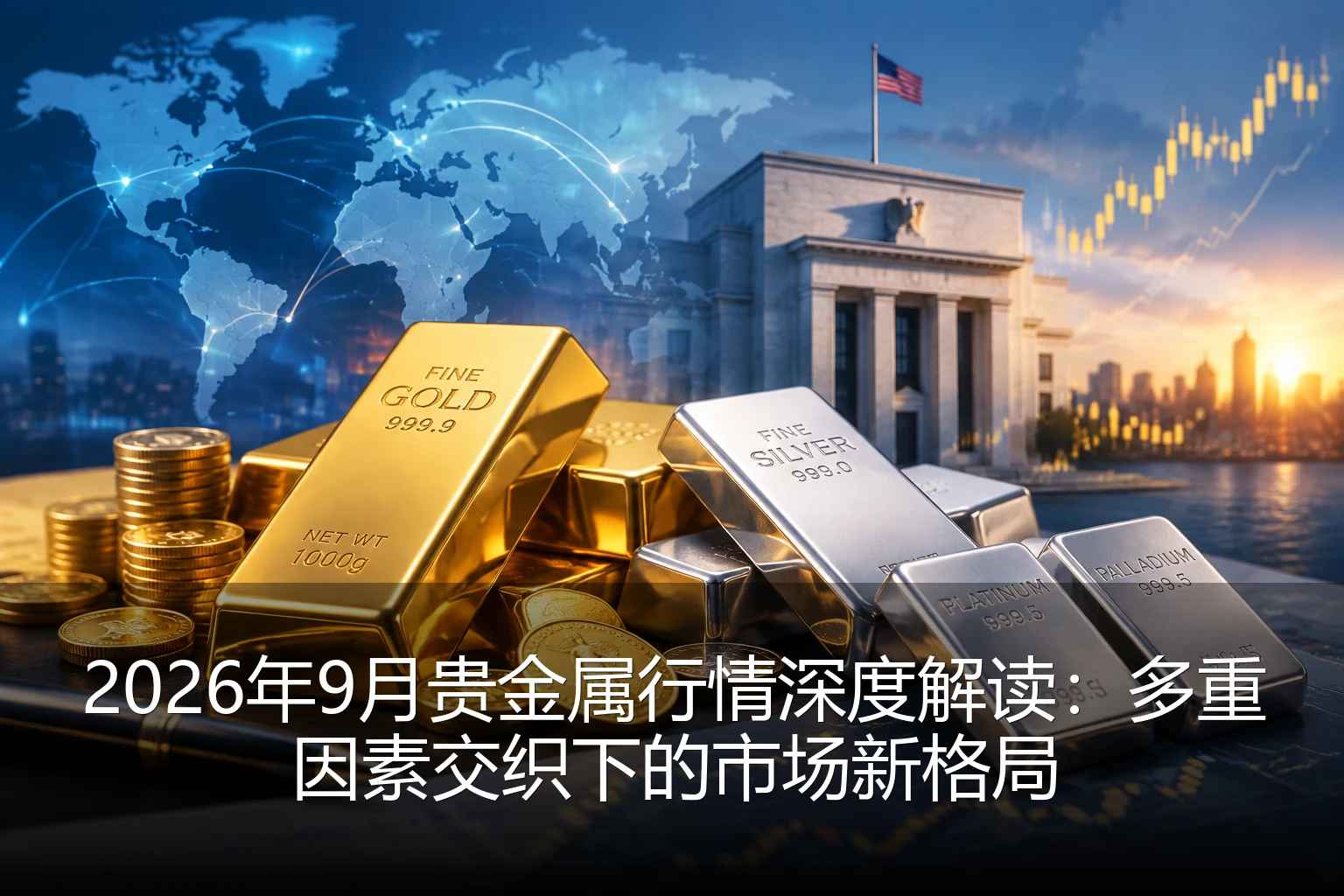
Gold Market Deep Dive for September 2026: A New Market Landscape Under Multiple Factors
The precious metals market in September 2026 presents an unprecedentedly complex pattern, with gold and silver, as precious metals, showing a volatile upward trend under the interplay of multiple factors. As a traditional safe-haven asset, precious metals once again become the focus of investors amid increasing global economic uncertainty. This article will deeply analyze the driving factors, price trends, and future investment strategies in the precious metals market.
Increased Global Economic Uncertainty Drives Demand for Precious Metals as a Safe Haven
Entering September 2026, the global economy faces multiple challenges: slowing growth in major economies, persistent geopolitical tensions, and inflation pressures that, although easing, remain above target levels. These factors collectively drive the increase in investor demand for safe-haven assets, benefiting the precious metals market.
According to the latest report from the International Monetary Fund (IMF), the expected global economic growth for 2026 has been revised downwards to 3.2%, a decrease of 0.3 percentage points from initial forecasts. Weak growth in major economies in Europe and Asia has exacerbated market uncertainty. Meanwhile, total global debt has surpassed a historic high of $340 trillion, with debt risks becoming increasingly prominent, further enhancing the safe-haven appeal of precious metals.
Central Bank Gold Buying Continues, Diversification Trend in Gold Reserves Becomes Clear
Central banks continue to be important participants in the gold market. Data shows that central banks worldwide have held gold reserves for 21 consecutive months, with purchase volumes reaching a new historical high. Central banks in emerging market countries are accelerating the diversification of foreign exchange reserves, reducing reliance on US dollar assets and increasing the proportion of gold reserves.
The South Korean central bank recently announced the resumption of its gold buying program after a 13-year hiatus, which is seen as a response to current global financial system uncertainty. Meanwhile, central banks in Southeast Asia and the Middle East are also increasing gold reserves to cope with potential financial risks. Central bank gold buying not only provides a solid bottom support for the gold market but also changes the supply and demand structure of the global gold market.
Expectation of Fed Policy Shift Brings Positive News to Precious Metals
The direction of the Federal Reserve's monetary policy is a key factor influencing precious metal prices. As inflation data in the US cools, expectations for a Fed rate cut in September are rising. Although the Fed chose to hold policy recently, its statements signaled dovish hints, suggesting a potential rate cut in September.
Futures markets indicate that the probability of a Fed rate cut in September exceeds 80%, with a potential cumulative cut of 75 basis points before year-end. This puts downward pressure on the dollar, which is favorable for precious metals priced in USD. Historical data shows that Fed rate cut cycles are often accompanied by rising gold prices, and these expectations are already driving the gold market higher.
Technical Analysis: Gold Breaks Key Resistance Level
From a technical perspective, gold prices have broken the key resistance level of $4300 in September, setting a new seven-week high. This breakout not only confirms the upward trend in the gold market but also opens space for further rise. Technical indicators show that the Relative Strength Index (RSI) for gold has entered overbought territory, suggesting a potential short-term technical pullback, but the medium-term uptrend remains intact.
Silver price trends also deserve attention. The precious metal ratio has fallen below a historical low, indicating that silver's valuation relative to gold is at a historical low. This phenomenon is underpinned by the recovery in silver industrial demand and the renewed market recognition of silver's hedging attribute as "gold for the poor." Silver technical patterns show that the price has broken a key resistance level and is expected to initiate a new upward trend. Platinum and Palladium: Dual Drivers of Industrial Demand and New Energy Transition Unlike gold and silver, the prices of platinum and palladium are more influenced by industrial demand. With the rapid development of the global hydrogen economy, the application of platinum in the fuel cell field is expanding, and industrial demand continues to grow. Data shows that the supply and demand deficit in the platinum market has expanded to historic highs, causing prices to set new historical highs. For palladium, the rapid development of the automotive industry, especially new energy vehicles, continues to drive palladium demand. Although electric vehicles reduce the demand for traditional catalytic converters, the rise of hybrid vehicles and hydrogen fuel cell vehicles provides new growth points for the palladium market. Meanwhile, geopolitical risks in Russia as a major palladium producing country also provide support for palladium prices. Investment Strategy: Diversified Allocation to Capture Precious Metals Opportunities Facing the complex precious metals market, investors should adopt a diversified allocation strategy. First, appropriately increase the proportion of gold in the investment portfolio as an important tool for hedging systemic risk. Gold ETF holdings data shows that institutional investors are continuously increasing their holdings of gold ETFs, a trend worth watching. Second, monitor changes in the precious metal ratio; when the precious metal ratio is at a high level, increasing the allocation to silver may bring excess returns. The current precious metal ratio has fallen to a historical low, highlighting the relative investment value of silver. Furthermore, platinum and palladium, as industrial metals, have long-term investment value in the context of the new energy transition, suitable for investors with higher risk tolerance. Finally, investors should pay attention to trading timing in the precious metals market. Technical analysis shows that gold and silver prices may face a short-term technical pullback after breaking key resistance levels, but the medium-term trend remains positive. For long-term investors, buying low is a more rational choice. Future Outlook: Precious Metals Market Still Has Upside Potential Looking ahead, the precious metals market still has multiple bullish factors supporting it. First, the trend of diversification of central bank foreign exchange reserves globally will continue, and gold's status as a reserve asset will be further consolidated. Second, as global debt levels continue to climb and monetary devaluation pressure increases, the demand for precious metals as a store of value will continue to grow. In addition, the industrial demand for platinum and palladium due to the new energy transition will remain growing, providing a fundamental basis for these two precious metals. Technically, gold prices have broken key resistance levels and are expected to challenge previous highs, and silver also has the potential to outperform gold amid the convergence of the precious metal ratio. However, investors should also pay attention to potential risk factors. The pace and intensity of the Fed policy pivot may affect the short-term trend of precious metal prices; the degree of global economic recession will determine the intensity of hedging demand; the development of geopolitical conflicts may also bring uncertainty. Therefore, investors should be cautious when allocating precious metal assets and manage risk well. In summary, under the confluence of intensifying global economic uncertainty, continued central bank gold buying, and expectations of a shift in US Federal Reserve policy in September 2026, the precious metals market is exhibiting a volatile upward trend. Investors should adopt diversified allocation strategies, focusing on the characteristics and investment opportunities of gold, silver, platinum, and palladium, grasping investment opportunities in the precious metals market while controlling risk.