Shanghai Gold Exchange Accelerates Opening-Up, Empowering Asia-Pacific Precious Metals Market Integration
Keywords: Shanghai Gold Exchange; Asia-Pacific Precious Metals Summit; gold market opening-up; Shanghai Gold benchmark; industrial chain synergy
Introduction
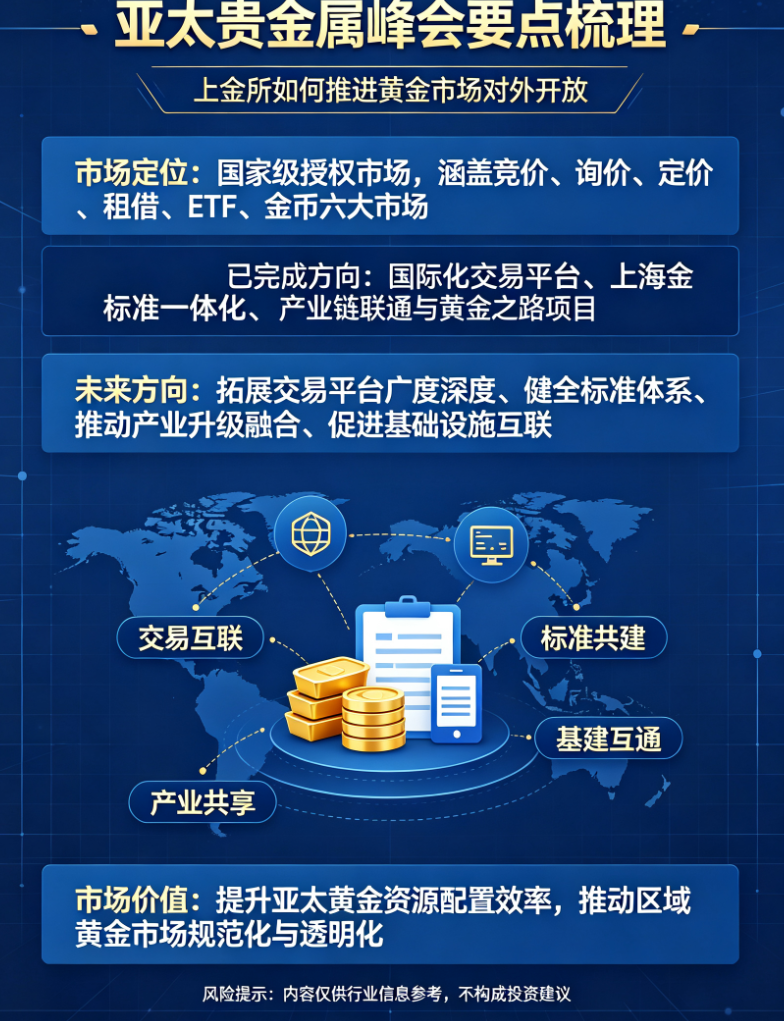
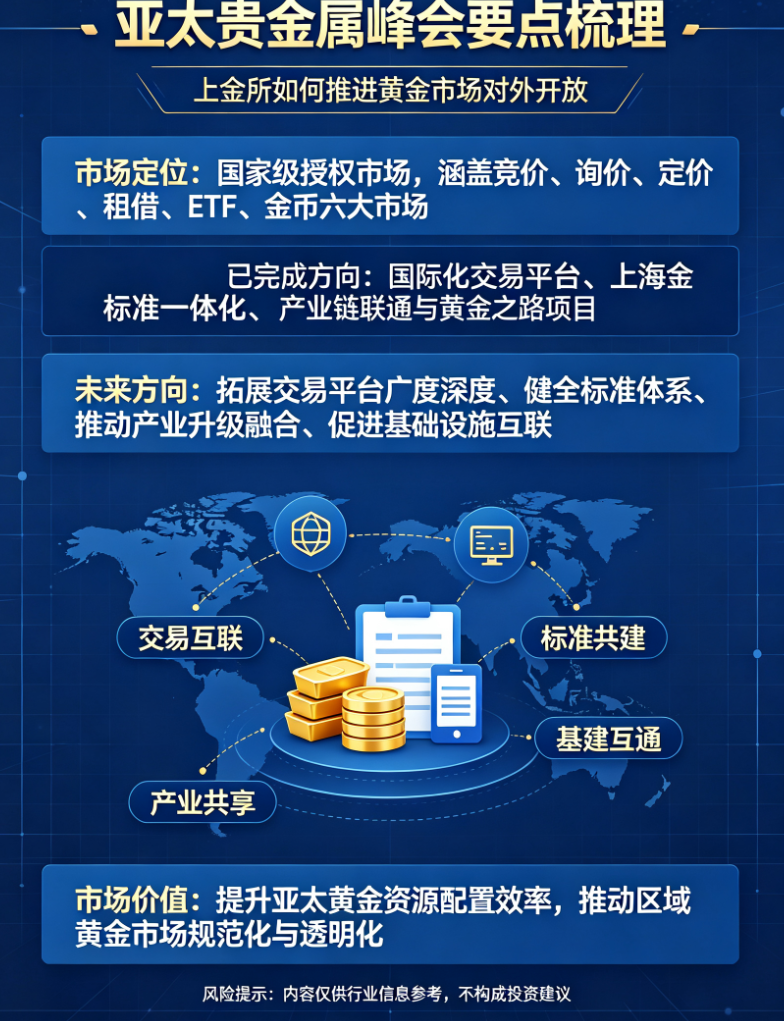
On June 5, at the 2023 Asia-Pacific Precious Metals Summit hosted by the Singapore Precious Metals Market Association, Li Ming, a supervisor at the Shanghai International Gold Exchange Center, gave a systematic introduction to the Shanghai Gold Exchange's opening practices and regional cooperation pathways. As a state-authorized market established by the People's Bank of China, the exchange has consistently followed a market-oriented and internationalized path. It has formed six complementary market systems covering bidding, inquiry, pricing, leasing, ETFs, and bullion coins, becoming a key hub in China's gold market and playing an increasingly important role in the global gold trading system.
1. Building an International Platform to Improve Resource Allocation Efficiency
Leveraging China's massive gold consumption and investment demand, the exchange has continued to advance international board development and open channels linking domestic and overseas markets. Since launching its international board in 2014, the number of international members has grown from the original 40 to 100, with about 70% from the Asia-Pacific region. The membership mix includes banks, dealers, brokers, refiners, jewelers, and other diverse participants. Trading volume has also achieved leapfrog growth, rising from more than RMB 45 billion in 2014 to RMB 2.09 trillion in 2022, fully demonstrating the platform's appeal and market depth.
At the same time, the exchange has actively expanded cross-market cooperation, jointly launching "Shanghai-Hong Kong Gold Connect" with the Chinese Gold & Silver Exchange Society in Hong Kong, and signing memorandums of cooperation with multiple institutions along the Belt and Road. It is exploring higher-level connectivity in trading flows, information flows, and personnel flows, driving regional markets from "single-point cooperation" toward "systematic synergy".
2. Advancing Standard Integration to Strengthen Market Rule-Making Influence
In the Asia-Pacific precious metals market, inconsistent standards often mean higher trading costs and lower circulation efficiency. The Shanghai Gold Exchange introduced the "Shanghai Gold" benchmark system precisely to improve price transparency and international recognition with pricing and delivery rules better suited to regional market needs. At present, the Chicago Mercantile Exchange and the Dubai Gold and Commodities Exchange have both listed Shanghai Gold futures contracts, and the London Bullion Market Association has also been working with the exchange on standard setting and mutual recognition, further expanding the international influence of Shanghai Gold.
This benchmark system not only improves pricing efficiency, but also offers the Asia-Pacific market a "Chinese solution" worth referencing. As more institutions participate in Shanghai Gold pricing, the regional gold market is gradually shifting from a price follower to a rule participant.
3. Linking the Industrial Chain to Drive Regional Synergy Upgrading
Asia-Pacific, especially ASEAN, is rich in gold resources and seeing rapid growth in consumer demand, while China has a complete gold industrial chain, advanced mining and refining capabilities, and strong design and processing expertise, giving both sides clear complementary advantages. To address this real-world need, the exchange launched the "Gold Road" project and implemented business models such as "gold leasing + jewelry processing" and standard gold ingot processing and re-export, helping companies cut costs and improve turnover efficiency while enabling smoother flows of capital, technology, and resources.
The significance of this approach lies not only in business innovation, but also in driving the industry chain to shift from "dispersed supply and demand" toward "joint development through coordination." By deeply integrating finance with the real economy, the regional gold industry is expected to achieve higher-level efficiency gains and value reconstruction.
Conclusion
Looking ahead, the exchange will continue to focus on four areas: expanding the trading platform, strengthening the benchmark system, advancing industrial chain upgrading, and promoting infrastructure interconnection, further raising its level of opening-up. For the Asia-Pacific gold market, this is not only a capacity expansion of the trading platform, but also a deep integration of rules, standards, industry, and capital. As cooperation between China and regional economies such as ASEAN continues to deepen, the Asia-Pacific precious metals market is expected to take more solid steps toward standardization, transparency, and integration.