Service Engine Stalls, Recession Warning Signals Flash
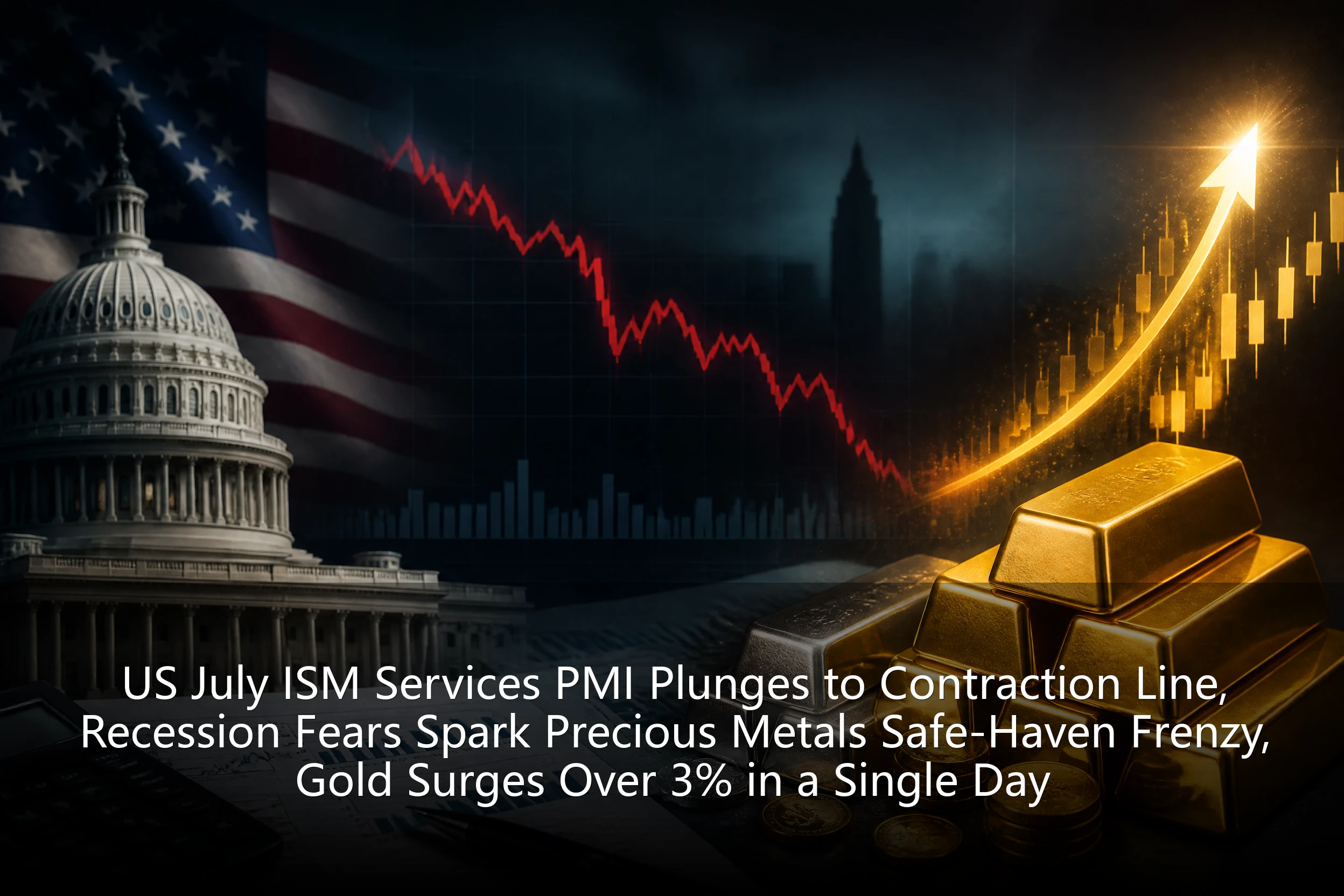
On Monday, August 4, 2026, the precious metals market experienced violent fluctuations triggered by macroeconomic data. The latest data released by the Institute for Supply Management (ISM) at 10:00 AM Eastern Time showed that the US July ISM Non-Manufacturing Purchasing Managers' Index (PMI) registered 48.8, far below the market expectation of 52.5 and marking the first drop below the 50 contraction line since mid-2024. This data hit the market like a thunderbolt, instantly shattering illusions of a 'soft landing' for the US economy.
As the services sector accounts for nearly 80% of the US economy, the collapse of this PMI data carries strong signaling significance. Sub-index data showed the Business Activity Index plunged from 54.3 in June to 47.2, the New Orders Index plummeted to 46.8, and the Employment Index barely held at a stagnant 50.2. This indicates that after a two-year aggressive rate hike cycle, even with several small rate cuts by the Federal Reserve in the first half of 2026, the lagged effects of tightening policy are still deeply eroding the core momentum of the economy. Consumers, under the dual pressure of inflation eroding savings and sluggish real income growth, have finally begun to significantly cut back on service spending.
Gold's Violent Rally: Concentrated Release of Safe-Haven Sentiment
Following the data release, financial markets experienced violent swings. The US Dollar Index plummeted over 1.2% in the short term, breaking below the 101 level to a near 6-month low; the 10-year US Treasury yield tumbled to around 3.55%, completely erasing previous gains driven by recurring inflation worries. Gold, as a zero-yield asset, demonstrated tremendous explosive power, benefiting from both falling interest rates and surging safe-haven demand.
Within one hour of the data release, spot gold prices soared from around $2,520/oz to $2,610/oz, a single-day gain exceeding 3.5%, not only breaking through the key psychological barrier of $2,600 but also setting a new all-time high. Meanwhile, trading volume for COMEX gold futures main contracts surged, and open interest expanded simultaneously, indicating a massive influx of hedge funds and institutional money frantically seeking shelter in the gold market.
'This is no longer a simple inflation hedge trade; it's a classic recession hedge trade,' noted a Singapore-based precious metals trader. 'When the services PMI falls off a cliff like this, the market realizes the Fed's previous rate cuts were far from sufficient, and the risk of a hard landing is rising exponentially. Gold becomes the only certainty asset.'
Silver Follows Suit: Industrial Attributes Temporarily Yield to Safe Haven
Driven by gold, silver prices also performed impressively. Although recession expectations theoretically weigh on silver's industrial demand, in the face of extreme risk aversion, silver's monetary attributes temporarily overpowered its industrial ones. Spot silver prices broke through $31.5/oz, gaining over 3%, with the gold/silver ratio briefly rising to around 83 before slightly retreating, indicating that silver's initial follow-up rally strength is typically weaker than gold's during early panic, but the subsequent catch-up potential is substantial.
Platinum and palladium showed some divergence. As the sharp drop in the services PMI directly sparked concerns about tightening auto loan credit, palladium prices retreated after a brief spike, reflecting pressure on industrial demand. Platinum, benefiting from its precious metals safe-haven premium, maintained a narrow range of slight gains.
Fed Policy Path Shifts: Calls for Emergency Rate Cuts Resurface
This disastrous PMI data completely altered market pricing for the Fed's subsequent policy path. Before the release, the market broadly expected a 25-basis-point rate cut at the September FOMC meeting. After the data, the CME FedWatch Tool showed the probability of a 50-basis-point cut in September surging to 78%, with some aggressive traders even betting the Fed might hold an emergency meeting in late August to announce a rate cut.
'If the upcoming non-farm payrolls data also shows a rapid deterioration in the labor market, the Fed will have no choice but to adopt more aggressive easing measures to rescue the economy,' said a Wall Street macro analyst. 'For precious metals, this means real yields will fall further, and the opportunity cost of holding gold will be unprecedentedly low.'
Subsequent Market Outlook and Investment Strategy
Looking ahead to the rest of this week, volatility in the precious metals market is expected to remain elevated. Investors need to closely monitor the upcoming US July non-farm payrolls report. If the jobs data also significantly misses expectations, gold could challenge the $2,650 level or even higher; silver may see a catch-up rally, with the gold/silver ratio likely to correct downwards.
For precious metals investors, maintaining a calm operational strategy is crucial in the current extreme market conditions:
- Trend Followers: Can moderately chase the rally, but must set strict trailing stop-losses to guard against technical pullbacks after data-driven bullishness is priced in.
- Long-term Allocators: The onset of a US recession cycle confirms the long-term bull case for precious metals; every deep correction presents a good opportunity to add positions.
- Short-term Traders: Should be wary of widening spreads caused by liquidity drying up, and are advised to control position sizes and avoid chasing long positions at the instant of data release.
Overall, the ISM Services PMI data on August 4, 2026, is likely to become a watershed moment for precious metals this year, marking a formal shift in market trading logic from 'the game between inflation and rate cuts' to 'economic recession and safe-haven preservation.'