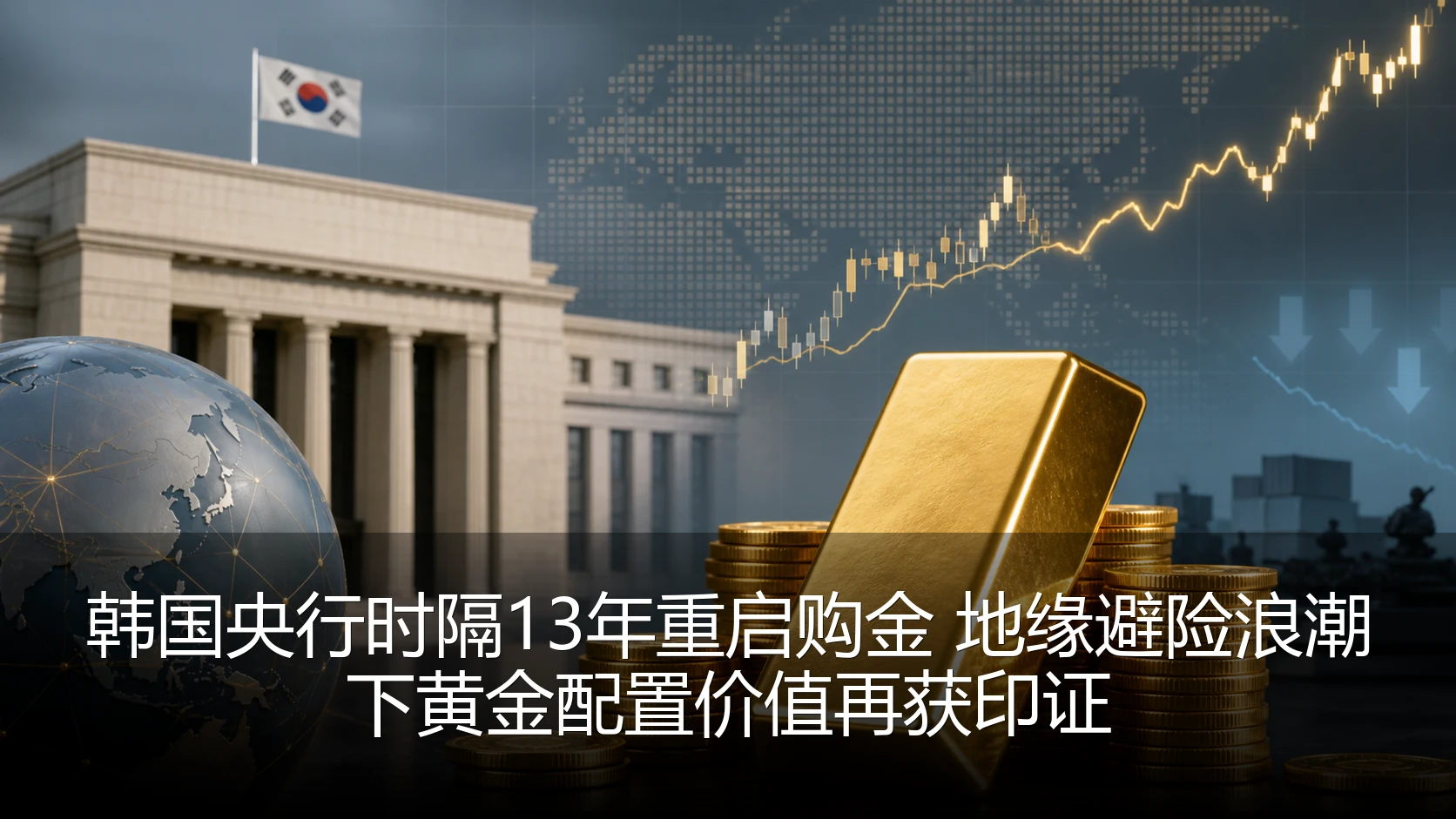
On August 7, the international precious metals market welcomed a landmark event—South Korea's central bank announced the restart of physical gold purchases after more than 13 years, and simultaneously deployed gold ETFs. This move was interpreted by the market as the addition of a new army to the global "gold buying tide", with the safe-haven allocation demand for gold accelerating under the drive of geopolitical risks. Boosted by the news, Hong Kong gold stocks continued to expand their gains in the afternoon, with Zijin Gold International once rising by more than 5%, and related stocks such as Zhaojin Mining, Zijin Mining, etc. also strengthening, with market sentiment significantly improving.
South Korea's central bank turns for the first time in 13 years, safe-haven attributes get official endorsement
The head of the foreign reserve management department of the Bank of Korea, in response to market concerns, said that rising geopolitical risks have significantly increased market attention to gold's safe-haven attributes, and coupled with gold prices having fallen from historical highs and price pressure having eased, the bank judges it necessary to expand gold holdings. This is the first time since the central bank stopped large-scale gold purchases more than a decade ago to return to the physical gold market, and it simultaneously configures gold ETFs, showing that its emphasis on reserve asset diversification and safe-haven allocation has significantly increased.
From a global perspective, South Korea's shift is not an isolated case. Data recently released by the World Gold Association shows that central banks and other official institutions worldwide net purchased 289 tons of gold in the second quarter of 2026, a year-on-year increase of 62%, with many emerging market central banks actively increasing holdings. The association's "2026 Global Central Bank Gold Reserves Survey" also shows that 45% of surveyed central banks expect to increase their gold reserves in the next year, a proportion at a relatively high level in the survey history. Central bank gold purchases are evolving from "defensive operations of a few countries" to "a global trend allocation", and the status of gold in official reserve assets is continuously rising.
Gold prices rise for four consecutive days to above $4300, multiple favorable factors jointly push
Under the dual support of the central bank gold buying tide and safe-haven sentiment, international gold prices have started a strong upward trend since August. Since August 4, London spot gold prices have risen from around $4100 per ounce, reaching a high of $4304.15 per ounce on August 6,刷新 the stage high since June 19; then slightly fell back to around $4250 to consolidate under profit-taking pressure. The strength of spot gold has also driven the performance of silver and platinum, with silver once approaching the $60 mark, and the gold-silver ratio rising again above 69 due to silver's callback.
This round of rise is jointly driven by multiple factors. At the macro level, US economic growth slowed in the second quarter, and June core PCE data showed that inflation continued to cool, market expectations for the Fed's aggressive interest rate hikes this year significantly decreased, the US dollar index and US bond yields fell from high levels, creating a favorable pricing environment for non-interest-bearing assets like gold. At the micro level, long funds have re-entered, COMEX non-commercial net long positions have significantly recovered from previous lows, and volatility has fallen to a low range, providing technical support for the rebound.
At the same time, the Middle East geopolitical situation has once again become a catalyst for safe-haven sentiment. The repeated negotiations between Iran and Oman regarding temporary navigation agreements in the Strait of Hormuz, and the actions of the Houthis pushing up international oil prices, have intertwined concerns about rising energy costs and supply chain disruption, with funds frantically flowing into traditional safe-haven assets such as gold and silver. It is worth noting that the rebound in oil prices has triggered inflation expectations, which in turn suppresses precious metals through the interest rate expectation channel. Multiple factors are engaged in fierce competition around the $4300 level, with gold prices showing significant short-term fluctuations.
Safe-haven allocation logic reshaped, de-dollarization and fiscal pressure form long-term main line
In the eyes of analysts, although this round of gold price rise has the characteristics of staged recovery, the long-term logic behind it is more critical. Shenyin Wanguo Futures analysis pointed out that the rise in global geopolitical risk center, continued intensification of US fiscal pressure, and the advancement of de-dollarization process, the trend of central banks increasing gold reserves will continue, and the price center of precious metals has the foundation for continuous upward movement. CITIC Futures analyst Shi Jialiang also believes that long-term favorable factors such as global central banks continuously increasing gold holdings and gold being favored by asset allocation funds have not changed.
Huachuang Securities released a research report stating that in the short term, cooling inflation and employment data have led to cooling rate hike expectations, and gold has welcomed a repair window; global gold ETF funds are gradually entering a net inflow state, and investment demand is expected to recover. In the long term, central bank gold purchases form a price bottom, and the long-term logic of de-dollarization has not been damaged. The current bottom position of gold is relatively clear, and valuation is expected to continue to recover. The allocation value of the gold sector and related assets is prominent, and it is recommended to pay attention to industry leaders and stocks with obvious growth.
Non-farm data determines short-term direction, rational allocation is the way for long-term
In the short term, market focus has shifted to the US non-farm employment report to be released on the evening of August 7. Analysts generally believe that this data will determine the height of this round of gold and silver price rebound: if the data is weaker than expected, rate hike expectations will further cool, and gold prices are expected to test the $4360-4380 range upward; conversely, if employment data is unexpectedly strong, be alert to the risk of gold encountering profit-taking and falling back to test the $4180-4200 support level after a rapid rise. From a technical perspective, if gold prices fall below $4250, they will test $4180 downward, and only by effectively breaking through $4300 can a new upward space be opened.
For ordinary investors, how to use gold as a safe-haven tool in a turbulent environment? Industry insiders suggest that gold jewelry刚需人群 can choose to purchase in batches when gold prices pull back, and prioritize comparing brand processing fees and premiums to avoid increasing costs due to chasing highs; medium and long-term asset allocation人群 can use low-volatility varieties such as gold ETFs and physical gold bars, adopting methods such as batch dollar-cost averaging or adding positions when prices fall sharply, with the allocation ratio controlled within 15% of total assets, to fully exert gold's value preservation function with a long-term holding mentality, rather than betting on short-term price fluctuations.
Overall, South Korea's central bank resuming gold purchases after 13 years is a vivid microcosm of the global central bank safe-haven allocation tide. Against the background of high geopolitical uncertainty, US dollar credit facing challenges, and continuous expansion of fiscal deficits in major economies, the status of gold as the "ultimate safe-haven asset" is being reconfirmed by more and more institutional investors. For investors, understanding the evolution trend of safe-haven logic may be more important than chasing short-term price fluctuations—stable asset allocation is always the cornerstone of protecting wealth in an uncertain environment.