Rising Middle East Tensions Trigger Sharp Volatility in Precious Metals: Why Did the Safe-Haven Logic Break Down?
Keywords: precious metals sector, gold prices, silver prices, Middle East tensions, U.S.-Iran conflict, inflation expectations, market sentiment, A-share market
Introduction
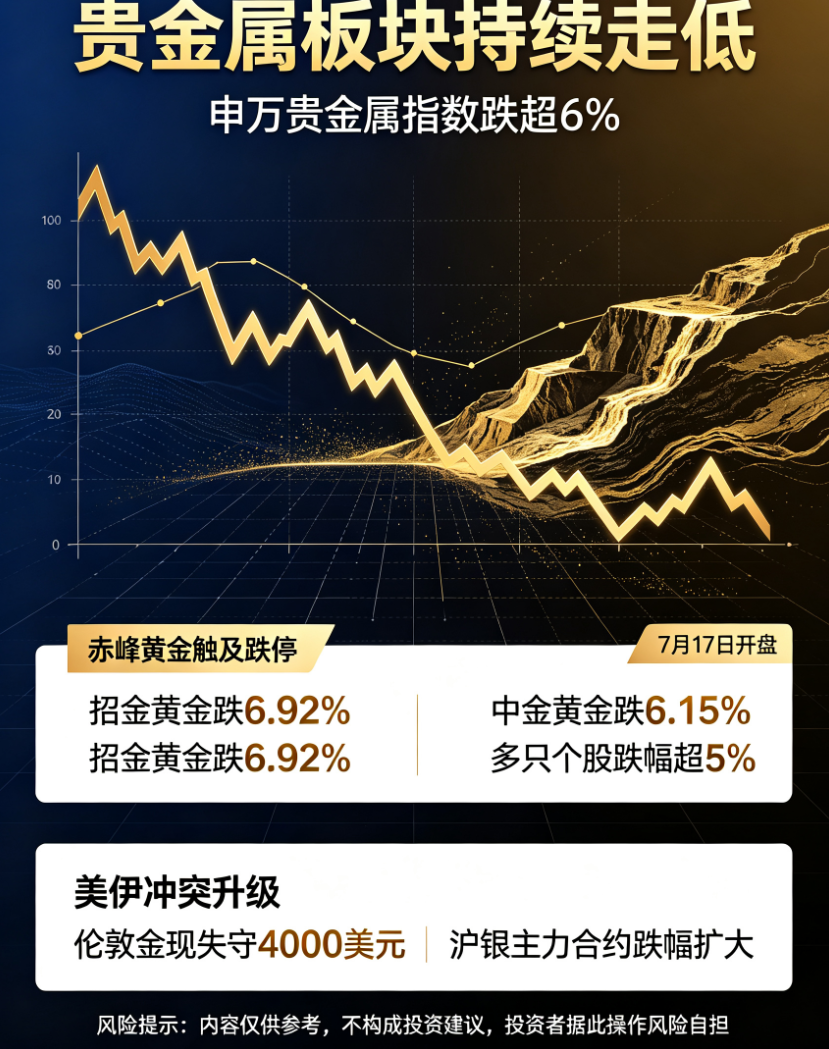
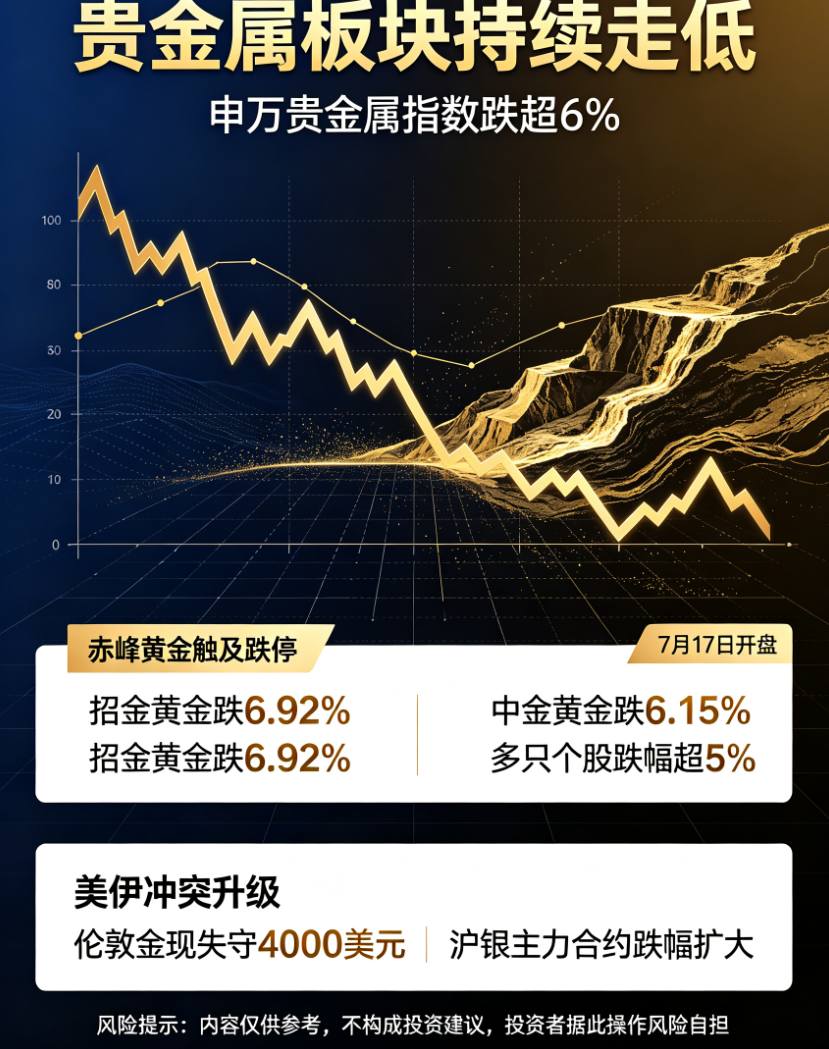
At the open on July 17, the A-share precious metals sector saw a clear pullback. The Shenwan Precious Metals Industry Index at one point fell more than 6% intraday, and many stocks in the sector came under pressure at the same time. As traditional safe-haven assets, gold and silver are usually in demand when geopolitical risks rise. Yet on that day, precious metals posted a rare broad-based selloff. This divergence reflects how the market is rethinking the Middle East situation, Federal Reserve policy expectations, and commodity pricing logic.
From a broader perspective, precious metals prices are not determined by a single event. They are shaped by the dollar trend, real interest rates, inflation expectations, risk appetite, and capital flows. The sector's retreat was driven both by the pullback in international gold prices and by a temporary cooling in safe-haven trading.
Broad Declines Across the Sector, Clear Pressure on Individual Stocks
In terms of market performance, the precious metals sector kept moving lower after the open. Chifeng Gold hit the daily limit down, Zhaojin Gold fell 6.92%, Zhongjin Gold fell 6.15%, and shares such as Xiaocheng Technology, Shanjin International, Hunan Gold, Sichuan Gold, Shandong Gold, and Western Gold all dropped more than 5%. The broad weakness across the sector suggests the decline was not caused by a single company's fundamentals, but was closer to a synchronized industry-wide adjustment.
It is worth noting that the precious metals sector had previously been supported by factors such as rising gold prices and stronger safe-haven demand, which had built up bullish expectations in the market. As international gold prices briefly broke below a key level, funds rushed to lock in profits, which further amplified volatility in the sector. For resource and commodity stocks, this kind of price-expectation-driven rally often sees an equally sharp reversal on the downside.
Geopolitical Conflict Escalates, Yet Precious Metals Fail to Extend Their Safe-Haven Rally
On the news front, the U.S.-Iran conflict continued to intensify. According to CCTV News, on July 16 local time, U.S. Central Command announced that U.S. forces had begun a new round of airstrikes against Iran at 2:00 p.m. Eastern Time, marking the fifth consecutive night of strikes. Further tension in the Middle East would, in theory, lift risk aversion and support gold.
However, market action showed that precious metals did not extend their gains as expected. On July 16 local time, spot gold in London fell 2.03% to $3,977.41 per ounce, slipping back below the $4,000 mark. COMEX gold futures fell 1.77% to $3,979.9 per ounce. Spot silver in London also plunged 4.02% to $55.508 per ounce. By 11:00 a.m. Beijing time on July 17, spot gold in London had edged up 0.05% to $3,979.968 per ounce, but it was still clearly below $4,000; the main continuous Shanghai silver contract was at 13,347 yuan, down 4.91%.
This shows that even as geopolitical risks kept escalating, the market was no longer simply trading on a linear "higher risk equals higher gold" logic. The reason is that part of the conflict escalation had already been priced into earlier gold moves. When the marginal shift in safe-haven sentiment failed to match expectations, profit-taking and technical selling pressure were quickly released.
Gold and Silver Pull Back Together: What Is the Market Trading?
At a deeper level, the synchronized weakness in gold and silver shows that the market is shifting from a "geopolitical shock" framework to a repricing around inflation and interest-rate expectations. The tense situation in the Middle East is pushing up oil prices and indeed intensifying global inflation concerns. At the same time, if higher oil prices raise worries about the global growth outlook, risk assets and commodities can come under pressure together.
Beyond safe-haven demand, gold's core pricing logic is closely tied to real interest rates. When nominal rates stay high and changes in inflation expectations are not enough to materially lower real rates, gold's upside is often constrained. This is especially true when the dollar index remains relatively firm and market expectations for the pace of Fed rate cuts keep shifting; in that environment, gold tends to trade in a high-level range or even pull back temporarily.
Silver's trend is more complicated. Silver has both financial and industrial attributes. In a risk-off environment, it usually moves higher with gold, but when risk appetite weakens and manufacturing expectations come under pressure, its industrial-demand side can also weigh on prices. That is why London spot silver fell much more than gold that day: it shows that the safe-haven support from its financial characteristics was not strong enough, and it also reflects growing concern about a slowdown in global economic activity.
What Does This Mean for A-Share Precious Metals Stocks?
For A-share precious metals companies, sharp swings in international gold and silver prices directly affect share performance, but the two do not always move in lockstep. In the short term, share prices are influenced by futures prices, exchange-rate moves, fund sentiment, and overall market risk appetite. In the medium to long term, they depend on mine output, resource reserves, cost-control capability, and a company's earnings flexibility during gold-price cycles.
From an industry perspective, if gold remains in a high-volatility range, leading miners may still be able to maintain relatively strong earnings resilience thanks to resource quality and cost advantages. But if prices repeatedly fall below key round-number levels, the market may quickly cut profit-growth expectations, and valuations will come under pressure as well. The broad decline in the sector today sends investors two reminders: first, precious metals are not one-way assets; second, sentiment-driven rallies often come with stronger downside risk.
In addition, the market should watch how oil prices affect inflation a second time. If crude oil keeps rising, global inflation expectations could pick up again; but if tensions ease and oil prices fall back, safe-haven funds may leave precious metals further. In other words, the precious metals sector is likely to remain in a high-volatility environment with both bullish and bearish forces at work for some time.
Outlook: Short-Term Volatility Is Rising, and Three Key Variables Will Matter
Looking ahead, whether precious metals can stabilize again mainly depends on the following three variables:
First, whether geopolitical tensions continue to escalate.
If the U.S.-Iran conflict widens further, safe-haven demand may rise again and gold could regain support; if tensions ease marginally, gold may continue to trade sideways with swings.
Second, the direction of the dollar and real interest rates.
If the market strengthens expectations for Fed rate cuts again, gold's portfolio value could improve; if the dollar strengthens and rates stay high, precious metals will face greater pressure.
Third, how inflation and growth expectations evolve.
The interplay between import-driven inflation from higher oil prices and expectations of slower economic growth is often complex. If the market judges inflation pressure to be more persistent, gold may receive medium-term support; if recession worries take over, silver and other more industrially sensitive products may face more obvious pressure.
Overall, the precious metals sector still faces significant near-term volatility, and chasing rallies or selling into weakness carries high risk. For investors, it is more important to track marginal changes in international gold and silver prices, the dollar trend, and macro policy signals than to rely on a single geopolitical event to determine direction.
Conclusion
This sharp drop in the precious metals sector shows that the market's pricing of safe-haven assets is gradually shifting from event-driven trading to a broader contest involving interest rates, inflation, and liquidity. Escalating tensions in the Middle East have indeed lifted the risk premium, but that does not mean gold and silver will keep rising in a straight line. On the contrary, when expectations have already been priced in, profits are taken, and technical support breaks, precious metals can also correct quickly.
For investors, understanding the multiple attributes of precious metals is especially important: they are both a safe-haven tool and rate-sensitive assets, and they also reflect global macro expectations. Over the next period, gold and silver prices will likely remain highly volatile, with both opportunity and risk in the sector. In a complex environment, staying rational and managing position size may matter more than chasing short-term moves.