Precious Metals Sector Under Pressure: How Are Short-Term Volatility and Medium- to Long-Term Logic Playing Out Behind Weak Gold and Silver Prices?
Keywords: Precious metals sector, spot gold, spot silver, rate-cut expectations, Fed meeting minutes, gold stocks, market pullback, long-term outlook
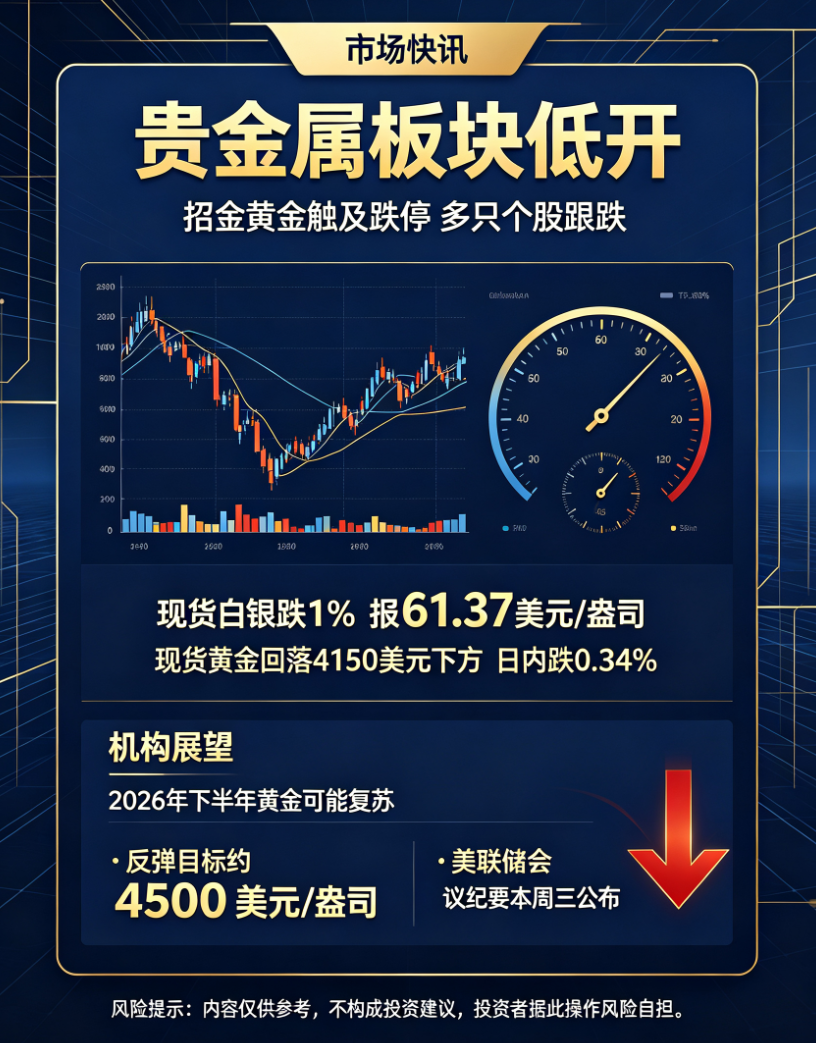
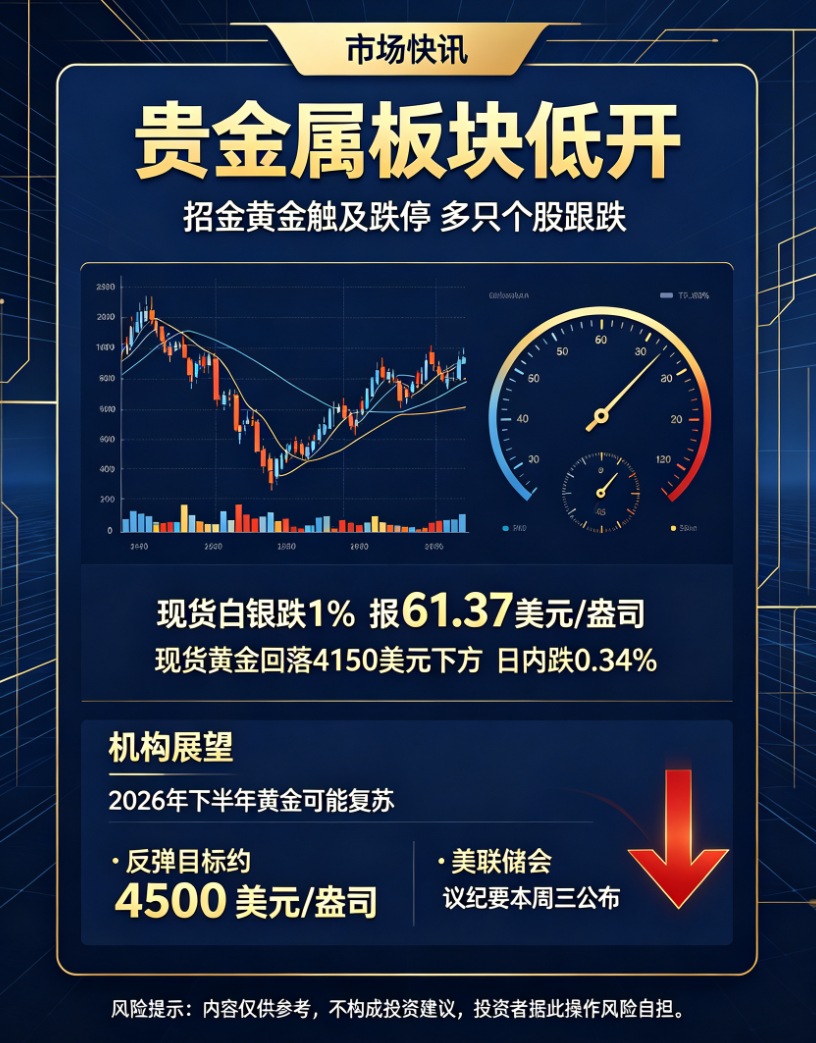
On July 7, A-share precious metals stocks opened sharply lower. Zhaojin Gold (000506.SZ) hit the daily limit down intraday, while Hunan Silver (002716.SZ), Chifeng Gold (600988.SH), Xingye Silver and Tin (000426.SZ), Xiaocheng Technology (300139.SZ) and Western Gold (601069.SH) also fell. The sector was broadly weak. International precious metals prices moved lower as well: spot silver widened its intraday loss to 1% to $61.37/oz, while spot gold slipped back below $4,150/oz, down 0.34% on the day.
This pullback is not surprising. Gold and silver had been rising steadily on safe-haven demand, central-bank buying and easing expectations, building up sizable gains and sharply increasing market sensitivity to valuation, positioning and policy paths. Once the marginal positives weakened, precious metals were among the first to enter a technical correction. For investors, the key question now is no longer just how much gold has fallen, but why it fell, how long it may fall, and how the market may rebalance after the pullback.
1. Precious metals sector pullback: price swings are being transmitted to equities
Changes in precious metals prices are usually quickly reflected in related A-share sectors. Gold and silver have both commodity and financial attributes, so price swings affect not only spot and futures markets, but also upstream mining, refining companies and related resource stocks.
From the tape, this drop showed two features:
First, leader stocks and high-beta names were under pressure at the same time, suggesting the market was not merely re-rating a single stock, but repricing the entire precious metals trading chain;
Second, silver fell slightly more than gold, showing that capital was under greater pressure to take profits in names that had run harder and had stronger speculative characteristics.
Silver has always been more volatile. Its industrial demand, liquidity and price elasticity often make it rise more sharply in rallies, but also overshoot more easily in pullbacks. Gold also retreated, but the decline was milder, reflecting its stronger safe-haven role and the heavier presence of institutional holders.
2. Why spot gold and silver weakened: short-term shocks and expectation resets
From the news flow, the decline in precious metals prices was mainly driven by the following factors:
1. Recent gains were large, increasing the need for a technical correction
Gold had once approached its highs, and silver kept setting new local highs. After such a rapid run-up, some bulls chose to lock in profits, and concerns about downside risk at elevated levels made a pullback inevitable. In commodity markets, fast gains are often the prelude to a correction, especially when prices have already moved beyond what some funds see as a fair range, which tends to amplify volatility further.
2. Monetary-policy expectations remain uncertain
Precious metals are extremely sensitive to interest-rate expectations. The market had previously bet that the Fed would turn easier, but that view has not been smooth sailing. The upcoming Fed minutes for the June 16-17 meeting deserve close attention. That meeting was chaired for the first time by Wosh, and the minutes may offer more clues about policymakers' views on the rate path, inflation pressure and economic resilience.
If the minutes signal that rates will stay higher for longer, expectations for real rates could be revised upward, weighing on gold's appeal as an allocation asset. If the tone is more dovish, the market may strengthen its bets on the timing of rate cuts, and precious metals could find support.
3. Shifts in risk appetite are affecting safe-haven buying
Gold's rise is often accompanied by stronger safe-haven demand, but if global risk assets remain relatively stable, some safe-haven money may temporarily flow back into equities or other return-seeking assets. That weakens the marginal appeal of precious metals as a haven. Especially when sentiment shifts from extreme optimism to caution, precious metals are often the first holdings cut.
3. Diverging institutional views: long-term optimism and short-term caution coexist
Although near-term prices have pulled back, institutions remain divided on gold's medium- to long-term outlook, with a clear split between short-term caution and long-term optimism.
Navellier & Associates said gold could recover in the second half of 2026, supported by central-bank buying and potential monetary easing in Europe. The firm expects gold to rebound to $4,500/oz after falling about 25% from January's record high. This view emphasizes long-term structural factors: global central-bank demand for gold, changes in the monetary backdrop and geopolitical uncertainty may still provide a floor for gold prices over the medium to long term.
Meanwhile, JPMorgan said in a report last Friday that demand for gold in key areas may not be as strong as expected, so it capped its third-quarter gold target at $4,300/oz and sees $4,500/oz in the fourth quarter. Compared with the first view, JPMorgan is more cautious in the near term, arguing that gold still has upside, but the pace will not be too linear and the climb may come with significant volatility.
This split actually reflects the core contradiction in the precious metals market:
On the one hand, the global de-dollarization trend, central-bank reserve diversification, geopolitical risks and a potential easing cycle all leave room for gold to run over the long term;
On the other hand, gold is already trading at relatively high levels and has become more sensitive to real rates, the dollar and demand shifts, so short-term volatility risk has clearly risen.
4. Looking at the chain, gold stocks are not just about gold prices
For A-share gold and silver stocks, the investment logic is not identical to spot prices themselves. Pricing also incorporates resource endowment, cost control, output growth, expectations for asset injections, overseas project progress and other factors.
For example, companies with stronger resource bases and clearer mine-expansion visibility often show more resilient valuations, while high-beta, low-liquidity names are more easily driven by market sentiment, with the pattern of overheating on the way up and falling too fast on the way down. After a short-term sector pullback, capital usually rotates back to companies with stronger fundamentals, more stable output and better cash flow.
Therefore, when looking at the precious metals sector, investors should not focus only on spot gold and silver prices, but also on companies' cost curves and earnings elasticity. A higher gold price does not necessarily mean every gold stock will benefit equally. Conversely, when gold prices correct, some better-run companies may prove more resilient.
5. What to watch next: three key lines of focus
Given the current environment, three themes deserve close tracking in the next phase of the precious metals market:
First, Fed policy signals
Minutes, officials' speeches, inflation data and employment data will continue to shape the market's view of the rate-cut path. If expectations for lower real rates strengthen, gold will get core support.
Second, the pace of central-bank gold buying
Central-bank buying has been one of the important forces supporting gold over the past few years. If major economies continue to diversify reserve assets, gold's long-term allocation value should remain elevated.
Third, the dollar and global risk appetite
Moves in the dollar index, geopolitical risks and market volatility all affect the flow of safe-haven money. A weaker dollar is usually positive for gold, while sharper swings in risk assets may also drive funds back into precious metals.
Conclusion
Overall, the July 7 pullback across precious metals stocks was both a direct reflection of lower international gold and silver prices and a stage-by-stage reset of the market's earlier overextended gains and policy uncertainty. In the short term, gold and silver prices may continue to fluctuate around key levels, and the sector will likely show more obvious divergence. But over the medium to long term, central-bank buying, a potential easing cycle, geopolitical risks and allocation demand still provide important support for precious metals.
For investors, the better strategy is not simply to chase rallies or sell on weakness, but to assess allocation value rationally by combining the macro rate environment, industry fundamentals and valuation levels. A pullback does not necessarily mean the trend has ended; more often, it is just a rebalancing within a longer-term move. In the coming days, the Fed minutes and subsequent policy comments may become the key variables determining the short-term direction of precious metals.