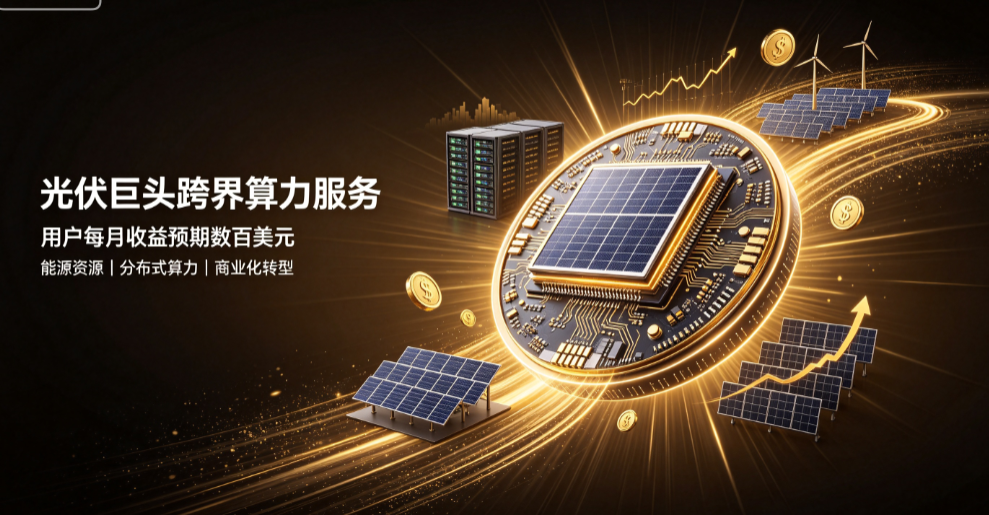
Cross-Industry Convergence: A U.S. Solar Giant Enters the 'Selling Computing Power' Track, Redrawing the Boundary Between Energy and the Digital Economy
Keywords
Solar industry, computing power economy, distributed energy, digital economy, business model innovation, energy transition, user earnings, blockchain technology
Introduction
At a time when the energy revolution and the digital wave are advancing in tandem, a striking development is reshaping the industry landscape: a major U.S. solar company has officially announced its move into the 'selling computing power' track, and its CEO boldly claims that users can earn hundreds of dollars a month by participating in computing power sharing. This cross-industry move not only reveals the deeper logic behind traditional energy companies' shift toward the digital economy, but also sparks broad discussion about how energy and computing power can coexist and thrive. When solar modules are no longer used only to generate electricity, but become the cornerstone of a distributed computing network, we may be witnessing a revolutionary shift in business models.
1. The Logical Convergence of Solar and Computing Power: The Evolution from 'Power Generation' to 'Compute Generation'
1.1 The solar industry's challenges and need for transformation
For a long time, the U.S. solar industry has faced severe challenges: unstable subsidy policies, insufficient grid absorption capacity, sharp electricity price swings, and high energy storage costs. The traditional 'sell electricity' model has hit a growth ceiling, and companies urgently need new revenue sources. Against this backdrop, combining solar systems with computing power services has emerged as a highly promising path.
1.2 The explosive growth of the computing power economy
The global digitalization process is accelerating, and demand for computing power in areas such as artificial intelligence, blockchain, cloud rendering, and scientific computing is rising exponentially. According to IDC, the global computing power market is expected to surpass $100 billion in 2025. However, traditional data centers are highly energy-intensive and constrained by geography and power supply, which creates a natural opening for distributed computing power.
1.3 The natural fit between solar and computing power
Solar systems are distributed, low-carbon, and prone to excess capacity during idle periods. By directly connecting solar generation to computing equipment such as mining rigs and AI servers, companies can build a closed-loop model of 'self-consumption first, shared excess compute.' This model not only solves the problem of absorbing solar power, but also reduces the electricity cost of computing facilities — the cost of solar power has dropped below 3 cents per kWh, far lower than industrial electricity prices. More importantly, solar installations are often located in sunny areas with low land costs, which are ideal for building low-cost computing nodes.
2. Decoding the business model: How can users 'earn hundreds of dollars' a month?
2.1 How user participation works
According to the solar giant, users only need to install a specific computing device on their rooftop solar system to become a 'computing node.' These devices run on solar power during the day and switch to grid electricity at night (or to storage batteries). Users receive token or fiat income based on their share of contributed computing power. The CEO's claim that users can make 'hundreds of dollars a month' is not groundless: assuming a typical household installs a 10 kW solar system that generates 40 kWh per day, with 30 kWh used for computing services, estimated at current mainstream computing returns, monthly income could reach $300-$500.
2.2 Economic analysis of the revenue model
In essence, this model is a hybrid of the 'sharing economy + energy services' framework. Revenue comes from three levels: first, the value of the computing power market itself (such as participating in blockchain network validation or providing AI training compute); second, excess profit from the cost advantage of solar electricity over grid power; and third, the green premium from carbon credit trading. When solar users sell idle computing power to companies or platforms that need it, they achieve almost zero marginal cost — because the marginal cost of solar electricity is close to zero.
2.3 Advantages over the traditional model
By comparison, under the traditional solar 'sell electricity' model, users earn only about $0.10-$0.20 per kWh (including subsidies), while 'selling computing power' can raise returns per kWh by 5-10 times. This is not only an upgrade in the business model, but also a redefinition of user value — solar is no longer just green energy, but a 'new infrastructure' node for the digital economy.
3. Industry Change and Challenges: Opportunities and Uncertainties in Cross-Industry Convergence
3.1 Impact on traditional energy and technology industries
A solar giant entering the computing power space will force traditional data center operators to rethink their energy strategies. Low-cost, clean, distributed computing supply may change the cost structure of cloud computing and edge computing. At the same time, cryptocurrency mining and AI companies will gain greener, cheaper sources of computing power, accelerating industry reshuffling. For the power grid, this model helps flatten peaks and fill valleys, improves renewable energy absorption, and may even give rise to a dual infrastructure of 'energy internet + computing internet.'
3.2 Potential risks and real-world challenges
However, this innovative model is not without risks. First, the computing power market is highly volatile, and changes in cryptocurrency prices and AI compute demand directly affect user returns; investors must be wary of the gap between 'expected returns' and actual results. Second, the upfront equipment investment threshold is relatively high, and the initial costs of computing servers, cooling systems, and intelligent control systems may weaken ordinary users' willingness to participate. Third, regulatory uncertainty: policies in U.S. states regarding distributed energy participation in the computing power market are still unclear, and financial compliance risks (such as token issuance) may also become obstacles. In addition, network security cannot be ignored — once a computing node is exploited by hackers, it may trigger systemic risk.
3.3 A sustainable and scalable path
To move from 'pilot' to 'scale,' three key issues must be solved: first, standardized interfaces and protocols to ensure seamless connection between solar systems and computing equipment from different brands; second, ecosystem building by creating an Uber-like computing power sharing platform to match supply and demand precisely; and third, financial innovation, such as asset securitization and revenue insurance, to reduce user risk. The solar giant has revealed that it is collaborating with several blockchain and AI companies to build an open ecosystem, which may be the key to breaking through.
4. Global Outlook: Implications and Competition for Chinese Solar Companies
4.1 Strategic thinking from a U.S.-China solar industry comparison
China is the world's largest solar manufacturer and installer, but the same 'selling computing power' model has not yet been deployed on a large scale. Behind this are both policy factors (China's restrictions on cryptocurrency mining) and insufficient coordination across the industrial chain. However, as the demand for computing power from AI large models explodes and carbon markets mature, Chinese solar companies have every opportunity to achieve a leapfrog advantage in areas such as 'solar + edge computing' and 'solar + carbon-neutral data centers.'
4.2 Diversified technology pathways
Beyond the single 'solar + mining rig' model, technology pathways can also include: solar + liquid-cooled AI clusters, solar + blockchain validation nodes, solar + IoT edge gateways, and more. Computing needs differ greatly across scenarios, so companies must choose the optimal combination based on their own resource endowments. For example, regions in western U.S. with strong sunlight are suited to energy-intensive computing businesses, while urban rooftop solar is better suited to low-latency edge computing scenarios.
Conclusion
The move by a U.S. solar giant into 'selling computing power' is by no means a mere business gimmick; it is an inevitable result of the deep integration of energy and the digital economy. It points to the most exciting possibility of the next decade: every rooftop solar panel is not just a generator, but also a 'money printer' — turning sunlight into digital assets through the computing power market. But the success of this cross-industry feast depends on technological maturity, regulatory wisdom, user education, and ecosystem coordination. For solar companies, embracing the computing power economy is not only a way out of subsidy dependence, but also the key to securing a ticket into the next era. For ordinary users, seizing this opportunity may mean truly realizing the dream of 'earning money while doing nothing' through energy democratization. However, as with all disruptive innovations, the road ahead holds both golden opportunities and thorny challenges. We wait to see what kind of future will be illuminated when sunlight meets computing power.